Thursday, November 6, 2014

Wise Oil and Veterans (Reflections on Pentecost 22 and Veterans Day)


Flag of the United States of America


I guess it's always something of a challenge for a liturgical preacher like my own dear self to try and marry the appointed text for a given Sunday with the secular holiday being celebrated at the same time. If you try to do it, you'll probably end up mangling the original meaning of the text in the attempt. But, shoot..! Here goes anyway.

The parable of the wise and foolish bridesmaids (Matthew 25:1-13) is another attempt by Jesus to tell us what living in God's kingdom and under God's rule is like. All ten maids know something is about to happen. The groom (let's make him analogous with Jesus) will certainly come to us at some point, but we need to be ready for the moment of arrival. I'm not sure that moment always has to be the Second Coming. Perhaps it's an illness, a death, a job loss, or even an unexpected blessing. The question is whether or not we're ready for it. What is the oil in the parable a metaphor for? It's got to be more than just correct doctrine. If we look at the Hebrew scripture lesson appointed for this week (Amos 5:18-24), we see that God has no time for religious observances if they're not connected to justice and righteousness.

So the next question would be, what do these qualities mean to you? What is righteousness? A pious Jew might find righteousness by being in constant dialogue with God's law, always asking what is the right course, the moral course, or the most acceptable. As Christians, however, we can't be in dialogue with the law because the law always shows us we have fallen short of it. Instead, our “oil” is to be in constant dialogue with Jesus, using the qualities we have learned from him as our guide. Which course is the most compassionate? Which the most forgiving? Which promotes peace and understanding and healing? Which the most beneficial to the suffering, the poor, the outcast? Which course is the course of love?

There are “Come to Jesus” moments in every life, and they come without warning. Those who have brought the oil of Christ's righteousness—his wisdom, his faith, his love—can't give it to those who are without it. It is up to all of us to cultivate our own relationship with Jesus, to watch for him and recognize what God is doing in our lives. The road to wisdom requires discipline.


So what does any of this have to do with Veterans' Day you ask? Honestly, not a darn thing. Except, I guess, that our walk with Jesus is preparation for any and every day. So let me just change the subject entirely and say a few words about our American secular holiday.

First, this holiday on November 11 was originally declared by Woodrow Wilson in observance of the end of the most ungodly bloodbath the world had seen up to that time—World War I. After an entire generation of young men in Europe and North America had been decimated by this carnage, Wilson thought it was a good idea to remember its horrors every year on the anniversary of the armistice in the hopes that such an event would never, ever reoccur. He further proposed that the victors of this conflict show mercy and compassion to the vanquished and create friendships and lasting peace through forgiveness and cooperation. This idea didn't go over too well at the time. A generation later we were slaughtering each other again. So Wilson's “Armistice Day,” intended to be a day to commemorate peace, was renamed “Veterans Day” to honor those who served and suffered in the defense of peace.

November 11 is also the feast of St. Martin of Tours, the patron saint of soldiers. The legend of St. Martin states that, as a soldier of the Roman Empire, Martin encountered a nearly naked beggar. Moved with pity for the man, the soldier cut his long cape in half and gave half to clothe the beggar. Later, in a dream, he saw the caped beggar and recognized that he had given his cape to Christ himself (See Matthew 25:36). He then left the military and dedicated his life to the service of God and the poor. Because of his act of selfless generosity, small churches were given the name “capella” or “little cape.” From this we get the words “chapel” and “chaplain.”

And, of course, November 11 is also the birthday of Martin Luther. Luther taught that a man could be a soldier and still honor God if he fought in defense of the weak and powerless. The temporal sword, according to Luther, if wielded by a righteous and God-fearing government, helped fulfill the first use of God's law, namely the suppression of lawlessness. (See Letter on Temporal Authority, 1523)

I hope we observe Veterans Day in the spirit intended by Wilson, St. Martin, and Dr. Luther. That is, we bring to the feast the oil of righteousness—compassion, mercy, and the desire for true peace—and not just flag-waving bravado. To honor those who sacrificed their youthful years in order that the world would be a safer, more law-abiding, and more just place, I offer a prayer by Luther and a litany of my own.

Luther's Soldiers' Prayer:

Dear God, you see that I must go to war. I would surely rather keep out of it. I do not rely and trust in the righteous cause, but upon your grace and mercy. I will not wage war against you, neither will I be in an army that robs God of the things that are God's. O heavenly Father, here I am employed as you will in this work and service of my rulers. My first loyalty is to you; then to them, for your sake.

I have learned through your gracious Word that our works cannot help us and that no one is saved by being a warrior. I will in no way rely on my obedience and work as a soldier. But I will sincerely do this work as a service to your will.

Enable me to believe with all my heart that only the innocent blood of your dear Son, my Lord Jesus Christ, obediently shed for me according to your gracious will can redeem and save me. In this faith I will stay here, wage war, do all that has to do with war, and if need be die. Dear God and Father, preserve and strengthen this faith in me through your Holy Spirit. I commend my body and soul into your hands. Amen.


A Veterans Day Litany

Spirit of the Living God, we give you thanks and praise for those who have given themselves to the cause of world peace, security, and justice. For all veterans and active duty military, we pray your blessing, your strength, and your healing love. We cry your mercy:

For those who have returned from service injured, whether in or out of combat, who have lost health or limb;

For those who suffer emotional pain;

For those who saw buddies killed or maimed;

For those who have seen sights they cannot un-see;

For those who feel guilt over the deaths of the innocent;

For those who know the pain of taking human life;

For those who turned to alcohol or drugs;

For those who were shunned, blamed, spat upon, or whose service was unappreciated or ignored;

For those who were victims of sexual misconduct;

For those who have suffered financial hardship because of multiple deployments;

For those who wonder why they were allowed to survive when others perished;

For those have missed holidays, birthdays, and the achievements of their children, or became strangers to their families because of their military service;

For those who attempted suicide;

For those who have not been able to feel pride, but rather shame for their actions;

For those who feel they haven't given enough;

For those who have become homeless;

For those who feel their government has let them down;

Lord, in your mercy, hear our prayer. Amen.

Thanks for reading, my friend. Stop in again soon.


Thursday, October 30, 2014

All Saints Day

What do John the Baptist and Kermit the Frog have in common?


The same middle name.
Kermit the Frog.jpgOkay. Dumb joke, I know. But it was the joke which my friend Pastor Kathleen Gahagen used to open her final sermon at Abiding Savior Lutheran Church of North Tonawanda, New York. Kathleen always began a sermon with a silly joke. She believed if there are no signs of joy in church, there is no joy. She was a sweet, funny, enthusiastic, and beguilingly friendly saint who lost her bout with cystic fibrosis last spring at the age of forty four. Blessed are the pure in heart, for they will see God.

My sister Maryanne ended her earthly journey this past year at the age of fifty-seven. She was a gifted scenic artist who had lived a wonderfully bohemian life in Manhattan for years, who traveled to Europe, and enjoyed multiple enthusiasm from classical singing to pro wrestling. Yet she turned her back on all that and chose to be a simple wife and mom, struggling to make ends meet in a very unglamorous job for a marketing company in Tacoma, Washington. I worried about her for years. In the end, however, I realized that a life has to be judged on balance, and that there is wonderful romance to be found in commonplace things. Blessed are the poor in spirit, for theirs is the kingdom of heaven.

My congregation, Faith Lutheran of Philadelphia, has lost five faithful members since last All Saints Day. Marilyn, who lost her only son and husband, but who taught us how to be family in Christ. John, who learned Spanish in his eighties and sent his first “tweet” at the age of ninety-three, and taught us all how to age with verve and joy. Doris, a shut-in who faithfully stuffed cash into an offering envelope every week, blissfully cheerful in spite of the grumpiness of her elderly husband, and smiling and perky even in her hospital bed. She taught us the value of patience. Chick, who was the most loving and compassionate step-father to his wife's children, who mowed the church lawn, made generous donations to the offering without calling any attention to himself, and never raised his voice above a hush. Bob, who mourned his first wife's death so deeply, but came alive again when he fell in love in his sixties, a virtual Lazarus, and testament to the goodness of God.

All of them are blessed saints—the meek, the mourners, the sweet and pure of heart, the poor in the things of this world but rich in the things of God. What is a saint, after all, but a sinner redeemed by God's grace?

I believe it is my purpose in life to be a bard for the everyday saints of this world. Every life, you see, is an epic. Every life has something to teach us.

And you too, my friend, are a saint—made holy even in your weakness—an ambassador for Christ.

May the knowledge of your own blessedness bring you peace.

Thursday, October 16, 2014

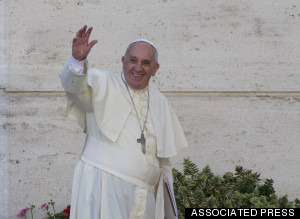
Saint of the Month: Pope Francis

 
About a year and a half ago I wrote a letter to Pope Francis requesting that the Holy Father consider ending the 500 year schism between Lutherans and Roman Catholics by inviting Lutherans into full Eucharistic sharing with our Roman brothers and sisters. I followed up my little epistle with a Change.org petition. Alright. I know. I may be a little crazy, but I'm not quite daffy enough to believe that I would really get a response to either missive. I just thought I'd run the idea up the pole and see if anyone saluted. Alas, Pope Francis is yet to reply. But that's cool--the guy's pretty busy these days. I certainly understand. My Change.org petition wasn't exactly a howling success either, running a full year and garnering only 47 signatures--mostly from friends and members of my congregation.

A Catholic buddy of mine, the permanent deacon of a local parish, made an interesting point. "Owen," he told me, "there will never be full Eucharistic sharing between Lutherans and Catholics until there's full Eucharistic sharing between Catholics." What my friend meant, of course, is that there are millions of good, God-fearing Roman Catholics who are disenfranchised by their own church, barred from the Holy Supper because of marital status or sexual orientation.

This week, the press that's coming from the Vatican Synod on Family Values suggests that Pope Francis is rethinking some of the Catholic Church's historic positions on divorce, cohabitation, and the LGBT community. If this is the case, he is the most radical Catholic since Pope John XXIII, and maybe the most radical since Martin Luther himself. Already the voices of dissent have been heard howling, calling for a fallback to the traditional views and vowing that a liberal pope will never reverse the church's teachings on these issues. (See this article) My deacon friend jokes, "I'm sure glad this guy cooks his own meals!" He's suggesting, of course, that so radical a change in church teaching is enough to make someone want to poison the old boy.

Okay. I get that. Such is the Pharisaical nature of our sin that we just have to have some category of persons to whom we can point and accuse of being worse sinners than we ourselves. But this never was the way of Jesus, and what I truly dig about this pope is that he's been giving us back the Jesus of scriptures.

I mean, aren't you just bored to tears with a blond, blue-eyed, lamb-carrying, namby-pamby Jesus--the Savior of all virtuous well-scrubbed white boys and girls? Me too. I want the world to see the Biblical Jesus: an heroic, willing martyr whose burning compassion for the poor and those outside of society challenges the self-satisfied status quo. I want to see a church which is not a country club for saints but a hospital for sinners.  

And as he sat at dinner in the house, many tax-collectors and sinners came and were sitting with him and his disciples. When the Pharisees saw this, they said to his disciples, ‘Why does your teacher eat with tax-collectors and sinners?’ But when he heard this, he said, ‘Those who are well have no need of a physician, but those who are sick. Go and learn what this means, “I desire mercy, not sacrifice.” For I have come to call not the righteous but sinners.’ (Matthew 9: 10-13)

I believe Pope Francis is doing more than just creating a "welcome environment." He's giving us the real Jesus--the one who comforts the afflicted and afflicts the comfortable. This is the only view of the Savior which truly speaks to our world. 

Thanks for dropping by, dear friends. Leave me a note and let me know what you think, okay?

Thursday, October 2, 2014

A Tough Parable (Reflections on Pentecost 17)


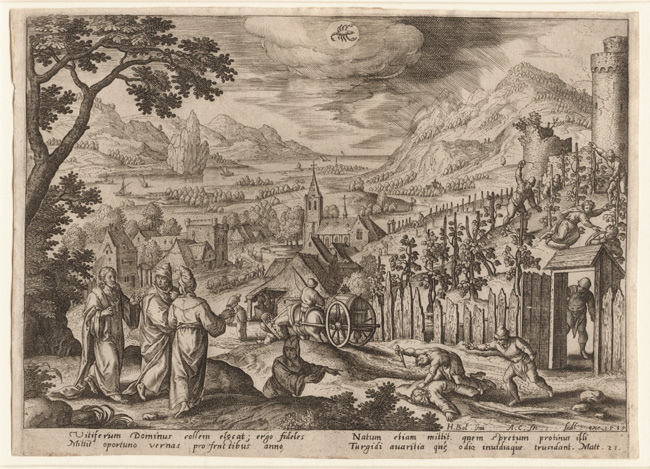
Collaert, October, with The Parable of the Wicked Tenants
Adriaen Colleart (1560-1618)
"The Wicked Tenants"
The parable of the "Wicked Tenants" (Matthew 21:33-46) is kind of a tough one for me to preach on. The obvious historical context of this parable is a little obscured. The smart guys in the Jesus Seminar say that when Jesus originally told this story, he left out the part about the vineyard being given to other, more qualified tenants (see the gnostic Gospel of Thomas 65:1-7). He might have just been giving a warning to absentee landlords—who were pretty common in his day—about what happens when you treat your tenant farmers harshly. The early Church, of course, added the bit about new tenants claiming the vineyard, thereby making it an allegorical story about how the Jews had screwed the pooch by rejecting the son (that would be Jesus) and the Kingdom of God now belonged to the new folks (that would be us).
To me, that theme just doesn't preach too well. It might leave us feeling awfully smug, but I'm not sure it draws us closer to Jesus. Besides, there's just too much us against them going on in the world now as it is, don't you think?

So let me try to pull something different out of this story. As it appears in Matthew's gospel, the landowner (that would be God if you want to get allegorical) is a pretty cool guy. He decked out this vineyard with everything necessary for the growing of good fruit and sustaining life. He then leased it to tenants. Leased it—that is, he made a contract with them. A covenant, if you will. Both sides know the score here. Alas and alack, the tenants chose not to honor the covenant.

As always in my way of thinking, the best didactic way to look at Jesus' parables or any of the Bible stories would be to cast ourselves in the role of the least sympathetic characters. So: wicked, sinful us (we?)—that's you and me—get the role of the covenant-breakers.

But this landlord is merciful. Even though the tenants renege on their remittance deal, the landlord still gives them three opportunities to do the right thing. So how come these “wretches” get put to a “miserable death?”

(By the way, I love the use of the term “wretches.” It has a double meaning. It can mean either a person who behaves wretchedly and is despised and scorned, or it can mean a person who is miserable and distressed. Charity suggests (don't you think?) that if someone behaves wretchedly it is because they are miserable and distressed. I, for one, never met a rotten,vicious person who seemed really happy. Have you? I mean, it's something to think about. We bring the punishment on ourselves.)

What's wrong with these tenants? First off, I'd say that they are ungrateful for the opportunity that the landlord has given them. They got their daily bread, but they don't seem to be thankful for it. There is a nasty sense of entitlement to these wretches which leads them to greater sins. They are also void of any sense of respect. Not only does their disrespect lead them to ingratitude, but it leads them to violence in that they cannot see the lives of others as being of value. Their overwhelming passion is for gain. They are covetous and grasping. Selfish, ungrateful, disrespectful murderers don't seem to have much of a claim on our sympathy.

So where does this leave us? To respect the landlord's son (yes, this is still Jesus) means to try to grasp the enormity of God's love for us—a love so great that God can enter into our suffering, providing us even his body and blood. This cognition leads us to a feeling of gratitude and respect. On the crappiest day we're ever going to have, God will still provide air and water, light and beauty, caring individuals in our lives, and the hope of eternity. The landlord has given us and will give us everything we need to bear fruit in our lives and be a blessing to others. And he asks so little in return—only that we find love in our hearts to do the right thing.

Thanks for stopping by this week. Leave me a note and let me know you were here.

Thursday, September 25, 2014

Impolite Christianity (Reflections on Pentecost 16)


Once upon a time, when I was a brand new pastor at Faith Lutheran of Philadelphia, I suggested to my congregational council that we change the way we do opening devotions at our monthly meetings. Rather than having the pastor lead in prayer, I thought it would be kind of peachy if individual members of the council took turns sharing their favorite scripture readings and leading in prayer themselves. After all, as Lutherans, we believe in the Priesthood of All Believers, and I thought it would be a good idea for us to share our spiritual side with each other.

One long-time, venerable member of the council announced to me that he had no intention of participating, and would not be taking a turn. “I don't do that,” he told me matter-of-factly.

As a new pastor I feared pressing my point, realizing that I can't force a man to pray publicly if he just doesn't want to do it. But this made me wonder: If this guy is a Christian and a leader of his congregation, why is he so against expressing his faith?

Maybe it's our old American tradition which our parents have passed on to us. It's just not right or polite to discuss religion in public. It's a private matter, and good Lutherans don't air private things in public. To a certain point I agree with this. I mean, I've seen boatloads of stuff on facebook which I don't believe I would share myself. Nevertheless, I can't help but feel that if there were ever a time for us to get over our religious shyness, this would certainly be the time!

In the Hebrew scripture lesson appointed for this Sunday (Ezekiel 18:11-4 and 25-32), the prophet reams out the exiled Hebrew people for blaming their parents for their current predicament. Certainly, the sins of the ancestors have caused great pain for the children, but there comes a time when the kids have to suck it up and get over it. They have to find their own sense of repentance and stop embracing their victimization and blaming Mom, Dad, and God for all of their problems. Repentance, change, and responsibility for their own identity is not only possible but necessary.

In the gospel lesson (Matthew 21:23-32), Jesus confronts the high priests and the Pharisees who see him as a huge threat to the status quo. They just don't like all this enthusiasm in their Temple, and they don't like the idea that some hick preacher from Nazareth can claim any authority. Jesus challenges their thinking with a parable about two boys and their dad. One openly defies his dad by refusing to do as directed, but later repents and does the chore anyway. The other says the right thing, but doesn't do what he's agreed to do.

I'm a little uncomfortable with this story because I find that I'm often like that second kid who knows what to say, but doesn't follow through. I mean, I know a LOT about the Christian faith, but in almost sixteen years in my parish I haven't been able to connect it to the hearts of this congregation. We still don't have an ongoing adult Bible class where we share with each other our relationship with Christ. I still see parents who do all the right things—they get the kids baptized, have them receive their first Holy Communion, and make their confirmations—but don't sit with them in church or have conversations about what their faith means to them. Secular activities seem to take precedence over religious observance with lots of folks, and I'm not sure that there's any discussion about how faith and “life” are integrated.

Of course, the good news in both of these lessons is that God desires repentance and doesn't care how late it comes. Sometimes hookers, thieves, and traitors get the message before people who have been raised in the Church. But God is merciful and desires a whole relationship with all of us.

I guess the question for me this Sunday will still be: What does your faith mean to you, and how is the world affected by the fact that you are a Christian?

Let me know what you think, and thanks for reading.


(PS-To see a video of me delivering the sermon for  Pentecost 16, click here.)

Thursday, September 18, 2014

We Are Beggars (Reflections on Pentecost 15)


Ruth was 85 years old when she left this world. Her first husband had been an abusive alcoholic, so she kicked his sorry butt to the curb and raised three children on her own. She endured the gossip of the neighbors who, back in the day, were censorious of a single, divorced woman. She worked six days a week and never took a penny she hadn't earned herself. She raised her children and cared for her aging mother. Eventually, she married a nice widower who predeceased her by twenty years.

Ruth's daughter told me about the lady hospice chaplain who visited her mother in the last weeks of Ruth's life. One day, as the chaplain read from the Bible, Ruth looked up from her bed and declared, “I'm just a speck of dirt. God is everything.”

Sometimes I have to marvel at a generation who worked so hard, endured so much, and yet felt no sense of entitlement. Some day soon they will all be gone, and our nation will be the poorer for the loss.

I see the scripture lessons appointed for the Fifteenth Sunday after Pentecost as dealing with our wounded sense of entitlement. The hilarious book of Jonah is really a remarkable writing. Not only is it a very funny story, but it is almost revolutionary when viewed in the context of its time. My friend Pastor Steve shared an interesting historical tidbit. It seems that the Assyrians, whose capital city Nineveh was, had a reputation for sadistic cruelty to the people they conquered which makes the Nazis look like unruly Cub Scouts (Not that unruly Cub Scouts can't be sadistically cruel, but you get the idea!). One can only imagine how much the people of Israel hated the people of Nineveh for what they had done to them in the days of conquest. Jonah going to Nineveh would be just like a Holocaust victim preaching to Berlin in the days of the Third Reich. This makes God's inclusivity and pity seem all the more radical, and Jonah's outrage at God's mercy seem all the more understandable.

The scandal of this story is equal parts God's profligate generosity and forgiveness and the hero's unattractive bitterness—a bitterness which makes him embarrassingly small-minded and silly.

Perhaps in our economy we are even more scandalized by the appointed gospel lesson, Matthew 20:1-16. I can't imagine a single union member who would be shouting “Amen!” to this parable. The guys who worked only a few hours get the same pay as the long-time employees..? That sucks! That's totally unfair—in our small-minded and silly way of thinking, perhaps, but not in the Kingdom of God.

“These last worked only one hour, and you have made them the equal of us who have borne the burden of the day and the scorching heat.” says a grumbling laborer in verse 12. God's answer? Yes. Yes, I have made the least of you as important and special in my eyes as the greatest. That's called grace.

To me, the great pity of this story is for those guys whom the landowner hires at five o'clock. When he asks them why they're standing idle, they reply, “Because no one has hired us.” When I was a teacher in the Los Angeles schools many years ago, I used to see groups of Mexican guys standing on street corners in the mornings, waiting for some gringo contractor to come by and hire them for a day of manual labor. I often wondered what happened to the guys who weren't picked for work that day. Did their families go hungry?

Anyone who has ever been out of a job for any period of time can sure sympathize with the guys who get hired last. They spent the whole day wondering if their families would eat that night. They must have felt like crap, and they would be grateful for anything that was offered to them at the end of the day. But imagine their joy and relief at being given a full day's pay! Contrast this with the bitterness of the guys who were given a full days' pay for a full day's work. They should have been grateful for the work, but their inflated sense of importance robs them of contentment.

The joy of the Lord comes only, I think, in acknowledging God's awesome goodness and mercy, and our own unworthiness. Like Miss Ruth who called herself a “speck of dirt,” Martin Luther's last written words were “It is true: we are beggars.” This was his testimony to the unconditional and unmerited grace of God. I get the feeling he died happy.

May you both live and die in God's mercy and goodness. It's so extravagant! Thanks for reading.

Friday, September 12, 2014

Holy Cross Day


No one has ascended into heaven except the one who descended from heaven, the Son of Man. And just as Moses lifted up the serpent in the wilderness, so must the Son of Man be lifted up, that whoever believes in him may have eternal life. ‘For God so loved the world that he gave his only Son, so that everyone who believes in him may not perish but may have eternal life. ‘Indeed, God did not send the Son into the world to condemn the world, but in order that the world might be saved through him. (John 3: 13-17)
Brosen icon constantine helena.jpg
Emperor Constantine and St. Helena with the Cross
from a Bulgarian icon.


First, a little geeky background on the significance of this holiday. You scholars of ancient history know that Christianity became legal in the Roman empire in 313 when the emperor Constantine the Great declared it was officially groovy to be a Christian. Supposedly, Constantine made this decision following his victory in the Battle of the Milvian Bridge fought the previous year. As the tale goes, Constantine was preparing to take his troops into the fray when he looked up at the sun and saw a cross glowing in the sky. Under the cross he read the Greeks words meaning, “By this sign you will conquer.” Not being one to shrug off a miraculous vision, Constantine ordered his soldiers to paint the Christian symbol known as the chi rho (XP—an abbreviation for “Christ”) on their shields. This they did and proceeded to thoroughly kick the butts of their enemies and win the day. Thereafter, the previously outlawed religion of Christianity became legal and, later, official.

That's the story, anyhow. Really smart historians who study this stuff suggest, however, that Constantine might have been Christian or leaning towards Christianity long before the Milvian Bridge episode. His mother, St. Helena, surely would have introduced him to the faith in his youth. He might have been just looking for a convenient way to go public with it. In any event, Constantine became Rome's first Christian emperor and founded numerous churches and cathedrals throughout the empire. Which brings us to the Feast of the Holy Cross. This yarn says that Momma Helena actually found the true cross upon which Jesus was crucified while on a pilgrimage to the Holy Land in 326. Her son ordered that this find should be commemorated by the building of a great basilica in Jerusalem on the site of Christ's burial where the true cross could be kept and venerated by the faithful. The church was completed in 335, and on September 14th the cross was taken out of the church in procession. The day has been celebrated by Christians as a minor church festival ever since.

Alas, the “true cross” is said to have been captured by invaders in 614 and then recovered in 630. Who knows? Fortunately, our faith in Christ does not depend on our faith in the validity of souvenirs, and the significance of this day does not depend on what Helena or Constantine thinks may of may not have been lodged in this grand old church. Rather, the essence of our spiritual life depends on the significance of this perplexing symbol.

Why, you may well ask, does the world's largest religion use as its emblem an instrument of terror and torture? Because it's precisely in this horrid device that God's love is most clearly seen. As the gospel lesson points out, “God so loved the world...” This doesn't translate as God really, really loved the world—although God most assuredly does—but that God loved the world in this manner, in the willingness to participate in our pain and brokenness.

Jesus says in John 3 that he will be lifted up just as Moses lifted the serpent in the wilderness. This is a reference to the Hebrew scripture reading assigned for this festival, Numbers 21: 4b-9. In this story, the children of Israel are afflicted while in the wilderness by poisonous snakes after they have spent considerable time bitching about how miserable their journey has been and what a rotten leader Moses is. Showing a gift for ironic humor, God makes their punishment fit their crime. After all, they have been creating disharmony by spewing poison from their mouths, so God gives them some really poisonous mouths to contend with. Their salvation is to look at the image of a snake Moses has placed on a high stick. That is, they have to look at their sin and at the thing that is killing them before they can be healed.

I find the serpent particularly meaningful as it puts us in mind of that crafty serpent in Genesis who claims that disobedience to God will make Adam and Eve be like God. This is, after all, our original sin—our desire to put ourselves and our desires on the throne ahead of everything and everyone else.

The wanderers of Israel had to confront their selfish small-mindedness, their ingratitude, their lack of faith, and their lack of respect and charity before they could be made whole. Similarly, we need to look to the cross of Jesus where we see our cruelty and our desire to objectify others. After all, the Romans used the cross as a weapon of terror. Crucifixions were meant to deter disobedience and enforce the will of one people upon another. They may have been partially successful to that end too, but crucifixions also bread resentment, hatred, and violence.

When we look to the cross of Jesus, we have to confront our sin, but we also confront God's everlasting empathy and love. Jesus went willingly to the cross out of love. Here we see God entering into our suffering. Without the cross we, could never really know God.

I guess I lose a little patience with TV evangelists who stand in front of huge spinning globes or maps of the world, supposedly symbolic of the spread of the gospel across the face of the earth. In the cross we see Christ's victory through his weakness and suffering. Unless we can recognize our need for repentance and God's forgiveness, unless we can recognize God in our suffering, we will never recognize God at all.

What do you see when you see the cross? What nails have you driven into the flesh of others? What nails have been driven into your own?

Thanks for reading, my friends.