Thursday, December 29, 2016

Reflections on the Feast of the Holy Name of Jesus

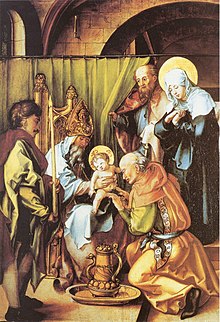
"Circumcision of Christ" by Albrecht Durer
“After eight days had passed, it was time to circumcise the child; and he was called Jesus, the name given by the angel before he was conceived in the womb.” (Luke 2: 21)

So what’s in a name? I really like my name—Owen. It’s a sign of my Welsh identity. I guess my dad wanted to preserve his ethnic heritage in me and gave me a specifically Welsh name. “Owen” means “Young Warrior.” Although I’ve never been a warrior and can no longer officially qualify as “young,” I’m proud of it all the same. I share it with a legendary Welsh rebel hero Owen Glendower (immortalized as a character in Shakespeare’s Henry IV Part 1) and with the mythical Welsh hero Sir Owen, Knight of the Round Table. When my father hung this moniker on me it was the 404th most popular boy’s name in the U.S. At the time, I was the only Owen I knew. Today, however, the name has risen in popularity even among the non-Welsh and is the 21st most popular boy’s name in the U.S.

In the U.K. they’d say that Owen is my Christian name. That title for what we Yanks call a first or given name comes from the tradition of officially naming a child at baptism or christening.

(BTW, here in Philadelphia, the term “christening” is often used synonymously with baptism. Technically, the two are not the same. Baptism is the sacrament of washing with water which officially makes one a Christian. Christening is the anointing with oil which is often done at baptism but is not, strictly speaking, a necessary part of the sacrament. I just thought you should know that!).

I suspect that the high infant mortality rate throughout much of human history is what prompted the postponement of naming until a child was officially introduced to the community. You wouldn’t want to bring a newborn (with a brand new immune system) out into the world until he or she had at least a week to get used to being born. In the world of our gospel text for this feast (Luke 2:15-21), a week had to elapse to make sure the child was strong enough to survive before parents would risk embracing the child’s identity. A baby like Jesus would be nameless until the eighth day when his vitality seemed a little more certain and he could be ritually received as a child of Abraham. So, too, we Christians used to wait until baptism before conferring a name on a child. This also explains our Western calendar. Jesus’ birthday might be celebrated on December 25th, but the Year of Our Lord couldn’t begin until the child had a name and an identity.

And what is that identity? Our Lord’s name is a contraction of a Hebrew name roughly transliterated as Yehoshu’a, which is usually translated to mean “Yahweh Saves,” or “Yahweh Delivers,” or “Yahweh Rescues.” It’s a variation on the name which we pronounce “Joshua,” too.

So what’s in a name?  What does the name of Jesus mean to you? I know I have so often used this sacred name in vain, and for lots of Americans it might be nothing more than a swear word. But what can speaking those sacred syllables do for us? We’re told that prayers are answered if prayed in the name of Jesus. So what is it about that name?

I think it might be a good idea for us to contemplate the name of Jesus from time to time. If Jesus’ identity is linked to his name—which scripture tells us it is (See Matthew 1:21)—how does that identity speak to you? Jesus is our Savior, but from what or for what are we saved or rescued? Traditional Church orthodoxy says that we are rescued by Christ’s atoning sacrifice on the cross from taking our own eternal punishment after death. Okay. That’s cool, but what does it mean for you now?

It’s really a bizarre thought to look at the figure of a man being tortured to death by being impaled on a cross of wood and associating that horrific image with being rescued. But that very image carries with it some powerful truths which my heart needs to embrace. The first is that suffering is real and unavoidable, and to speak the name of Jesus is to be reminded of one who suffers. Perhaps that is to move me to compassion and the knowledge of shared humanity. But then, speaking that name reminds me of God’s love in embracing our human suffering, participating in it, and enduring it without complaint or bitterness. Then the name of Jesus reminds me that suffering and death were not final. That name which his enemies hoped would die with him on the cross became, within a single generation, the name above all names. The crucified criminal’s name became the prayer on the lips of the Roman world.

When we say the name of Jesus we say that God rescues us. We are rescued from insular selfishness, from abandonment and worthlessness, and from the great evils of complacency and despair. How beautiful is the name of Jesus when we say it in faith and confidence!


Thanks for reading, my friends. May you all have a blessed, safe, and happy 2017 in the name of Jesus!
Wednesday, December 21, 2016

The Word Became Flesh (Reflections for Christmas Morning)

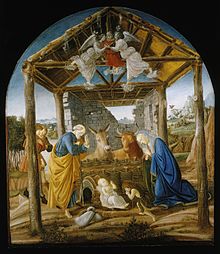
"Nativity" by Sandro Boticelli 1445-1510

And the Word became flesh and lived among us…(John 1:14a)

We all love the story of Christmas Eve—of the night when Jesus was born in a stable and the angel told the shepherds about the birth of the Messiah. But do you ever wonder what happened that next morning? I would think that after all of the excitement of the previous evening, what with a bunch of shepherds running through town glorifying and praising God for all that they had heard and seen, that our Holy Family would be pretty exhausted. I like to believe that all of the attention given to this new little baby would’ve prompted someone in town to offer the family a room in their home in which to stay until they completed their census duty in Bethlehem. Maybe news reached a distant member of Joseph’s family, and the mother and infant were taken in and given a proper bed or at least a clean mat on the floor.

I fancy that Joseph, early on this morning after being assured that his wife and new baby were safe and warm, headed out into town to do his civic duty and be registered. As with all bureaucratic activities, he probably had to stand in line somewhere while the officials shuffled papers and counted beans.

Maybe there was a guy in line next to him who struck up a conversation. “So you live here in Bethlehem or is your family from here?”

“My family. My wife and I live in Nazareth,” says Joseph.

“Nazareth, huh? That’s a long trip just to satisfy these Roman s.o.b.’s. Say! Did you hear those drunken shepherds last night? A whole bunch of these guys came runnin’ through town screamin’ and yellin’ and claimin’ that an angel told ‘em the Messiah had been born. You know anything about that?”

Joseph is silent for a moment. “Yes,” he says. “I think I heard something about that.”

“You couldn’t miss it,” the guy says. “Those clowns were sure makin’ a racket. It’d be nice if the Messiah really was born, though. We could sure use some help, times bein’ what they are. So you got any kids?”

“My wife just had a baby last night. That’s why she’s not with me.”

“No kiddin’? Last night? Hey! Maybe your kid’s the Messiah! Wouldn’t that be a hoot?!”

Joseph and the man chuckle. Joseph’s turn in line comes, he answers the Roman official’s questions, pays his registration tax, and goes home to check on Mary and the baby. Life in Bethlehem goes on as if nothing has happened.

And so life goes on for us, Christmas comes and goes, and we forget about the miracle that the Word became flesh and lives among us.

Somehow, the word “flesh” got a bad rap in our lexicon. We so often hear of “the desires of the flesh,” referring to sexual lust or some other kind of immorality. Lots of ancient philosophers acquainted “flesh” with impure, earthly matter as opposed to “spirit,” which was pure thought. We even repeat the old saying, “The spirit is willing, but the flesh is weak.” And we’ve developed a certain loathing for our own flesh. It’s never quite smooth or small or pretty or young enough, is it? We try to punish our flesh with dieting or alter our flesh with cosmetic surgery.

And yet, the very Word of God chose to become flesh and live among us.

The youngest person I’ve ever met was only fifteen minutes old—a tiny bundle of pink flesh, utterly helpless and small enough to fit into her father’s one hand like a football. But what power that small piece of mortality had! Her very weakness compelled all around her to gentleness, to compassion, and to the awe of human life. And there, in the wonder of a newborn, is the totality of God’s love. The Word becomes flesh so we can see it and know it and love it and recognize ourselves in it. God’s love is so vast. The Immortal put on mortality so we could know we are part of God. God is with us in all of our frailty. God loves us in our mortal flesh so much that he came to clothe himself in flesh and endure its weakness and pain.

The pageantry and hurry of the season will pass. The radio will stop playing Christmas songs by the stroke of midnight on the 26th of December. We’ll put the tree out on the curb and take down the lights. But the mystery of the Word becoming flesh must linger with us. In our moments of self-doubt and fear and worry we can know that God loves our weakness enough to share it with us. We are adored in the flesh. As the beloved carol says:

“Long lay the world in sin and sorrow pining ‘til He appeared and the soul felt its worth.”


A blessed Christmas to you all!

Tuesday, December 20, 2016

So Here's a Christmas Miracle (Reflections for Christmas Eve)

Do you believe in Christmas miracles? I guess I do. I remember the year my dad passed away right before Christmas and it actually snowed in Los Angeles! I like to think that was my Old Man telling God to cheer me up with a white Christmas. A few months ago I was listening to NPR and I heard the story of a man who found his entire life transformed in a church on Christmas Eve.

This guy's name is William Kitt. William is in his sixties now, and he's had a pretty darn interesting life. He's a Black guy who was brought up in South Carolina and he started getting in trouble when he was a little kid. He figured out that if you hit or tipped a vending machine in just the right way you could knock some of the change out of it. So he started ripping off vending machines and automats and got himself a juvenile arrest record by the time he was eleven years old.

For some misguided reason, William's mom moved with him to New York City. Maybe she thought a change of environment might keep the boy out of mischief. Who knows? Unfortunately for William, she decided  to abandon him as soon as he turned eighteen. He came home to find the apartment deserted and himself with no skills for paying bills or managing as an adult. Now you might think that an eighteen-year-old with a juvenile record might come to no good if left alone on the mean streets of New York.

And you'd be right.

After a brief stint in a homeless shelter, William took to the dirty streets like a lion takes to the Serengeti. He had an instinctive, native cunning about survival. All told, William would spend thirty-four years of his life as a street person. To his credit, he adopted one moral scruple--he would never steal from an individual. Instead, he would rip off institutions. One of his favorite cons was to steal bottles and cans from the city recycling center and then sell his loot back to the same center for cash. Of course, the biggest institution William could rob was the federal government. He made a brisk business out of forging identities. At one point he was conning Uncle Sam out of $2,000 a week in welfare checks. This con could, at the very least, put a roof over William's head had he not by this time developed a rather pricey addiction to heroine, cocaine, crack, and just about any drug he could lay his hands on.

Over time, the drug habit began to exact payment--both financially and emotionally. William began to hear voices--auditory hallucinations which robbed him of his sanity. He described the noises in his head as the voices of demons, goading him with foul and sinister thoughts, urging him to steal and filling his mind with scenes of violence. His very existence became one unimaginable nightmare.

And then came Christmas Eve 2003. For some inexplicable reason, the homeless junkie and conman took shelter inside a church. William says that sitting under the great arched ceiling gave him a feeling he'd never remembered having. Nothing if not a covetous man, William looked around at the faces of the worshipers as they sang the familiar hymns to celebrate the birth of the Christ child. "I wanted to have what they had," he said.

Shortly thereafter, having heard on  the street that a housing project was opening in Harlem with preferential treatment for the mentally ill, William approached a social worker and applied for an apartment at the Broadway Housing Communities. Always the conman, William declared himself to be schizophrenic. "I had to act crazy," he said. He put on a show for the psychiatrist, exaggerating the severity of the audio hallucinations he actually heard and was soon granted residency.

For the first several months William rarely stirred from his new home. He did not attend the community functions, nor did he seek rehabilitation or counseling for his drug addiction. Rather--miraculously--he just stopped taking drugs. And gradually, the demonic voices in his head grew silent.

Today William Kitt still lives in Broadway Housing in the same apartment he's had for thirteen years. He spends his time creating exquisite works of art, drawing scenes from around Manhattan which he renders in vivid pastel crayons. His works are vibrant and beautiful. He still claims, however, that he hears one particular voice, but says that it's the voice of an angel who inspires his artwork.

Does an angel really speak to William Kitt, or is it just the residue from his years of substance abuse? I don't know, but I like to think that if an angel would speak to a peasant carpenter, a teen-aged girl, or  group of dirty shepherds, one would certainly not disdain talking to a former homeless drug addict.

William is alive and healthy today because of a Christmas miracle. What drew him to that church thirteen Christmases ago? What drives any of us to church on this holy night? Only our soul's hunger to behold the Christ child and receive the peace this child has to give.

God bless you, my friends, and a Merry Christmas to you all.
William Kitt's portraits are based on his observations of the vibrant street life of Manhattan.
Some of William Kitt's art.
PS: You can read more about William Kitt by clicking here.

Wednesday, December 14, 2016

What Dad is This? (Reflections on Advent Four, Year A)

Saint Joseph’s Advent Angel and the Gift of Faith
“Joseph, son of David, do not be afraid to take Mary as your wife, for the child conceived in her is from the Holy Spirit.” (Matthew 1:20b)

So who is this guy Joseph? There’s not a whole heck of a lot the Bible tells us about him, but Matthew’s gospel for Advent Four (Matthew 1:18-25) calls him a “righteous man.” He discovered that his fiancĂ© was pregnant—and not by him! In the world of the text, this wasn’t very good news. If Joseph was really observant of Jewish law (see Leviticus 20:10), he’d be perfectly within his rights to drop the dime on Mary and have her stoned to death for fooling around with another dude. If he was really so “righteous,” wouldn’t he respect the law and rat her out for adultery? I mean, the law is the law, right?

Yet old Joe doesn’t do this. He chooses, instead, to let her get away with what he believes to be her crime and shows her mercy. This speaks pretty loudly to me. It suggests to me that when the New Testament talks about righteousness, it means something far greater than just observance of the law. True righteousness has to be about mercy, forgiveness, compassion, and love. It also has to be about acceptance, as Joseph is moved by his angelic visitor to accept a child who is not his own flesh and blood. His righteousness even extends to consideration of his wife’s physical needs since he respectfully abstains from newlywed nookie until after her baby is born (verse 25).

You have to admire the guy. Granted, as I said above, there’s not much we know about him. Scripture says he was a carpenter, and he was certainly a good dad as he protected Jesus from Herod in Matthew’s gospel and took him to Jerusalem for Passover in Luke’s account. After the Passover trip, however, he disappears from the story. Church tradition has sometimes held that Joseph was older than Mary and so left her widowed pretty early on. By the time Jesus starts his public ministry, there’s no mention of Joseph. It’s also been speculated that Jesus’ siblings were really Joseph’s kids from a previous marriage, and that Joseph never had any children (or even sex!) with Mary. That’s if you’re into the “perpetual virginity” doctrine about our Lord’s mom. I’m not sure the Bible really suggests this, but, hey! If it floats your boat, go with it.

What I really respect about Joseph—and certainly resonate with—is that he’s one terrific step-dad. Fatherhood, even if the kids are your own issue, has got to be hard enough. Choosing to love a child and assuming everything that comes with that child takes a truly righteous ability to love.

I never mind when someone in the community addresses me with the title of “Father.” Granted, Lutheran clergy haven’t used this title for a long time, but I think it’s one of the most respectful offices to which any man can aspire. Pastors and priests have something in common with male parents—we all have complete responsibility for something over which we ultimately have no control. And who’s to say that we don’t actually become family to the children in our charge?

My stepdaughter was all grown up by the time we came into each other’s’ lives. My Godchildren, nieces, and nephews grew up way across the country from where I live. I knew them as infants, but they’ve become adults in a shockingly short period of time without much—if any—interaction with their Uncle Owen. But for eighteen years I’ve watched the children of my parish grow, learn, graduate, get jobs, marry, have kids of their own, etc., etc. I’ve learned that there are lots of different ways to be “family.”

Like Joseph, we are all called upon to adopt strangers as our own. I’d be willing to bet that all of us have more than one father or mother. We’ve had teachers, coaches, scout masters, uncles and aunts, neighbors, and various non-blood relations who have grappled us to their bosoms with steel hoops of love and understanding.

This beautiful pre-Christmas story in Matthew’s gospel reminds us of the interconnectedness of our human family. All children are our children. All are children of God and members of the family. Lately, our public discourse here in the good ol’ US of A has emphasized the “otherness” of some of the children of this planet. I think this is a good time to remember that real righteousness goes beyond nationality or even blood ties. The children of immigrants, the children of Aleppo, the children of South Sudan and Flint Michigan are ours, too. In Christ, there is no “us” or “them.” There is only “us.”


Thanks for reading, my friends. And here’s a shout-out to all the other step-dads out there. God bless you in your parenting, and may the Lord make you a teacher and example of righteousness.

Wednesday, December 7, 2016

John's In Trouble (Reflections on Advent 3, Year A)


John the Baptist is really screwed. In this week’s lesson (Matthew 11:2-11) we find him in prison. As you can guess from last Sunday’s pericope, he’s pissed off some really important people. If we skip ahead to Matthew 14:1-12, we learn that John got arrested for calling out King Herod for sexual immorality. You have to admire the Baptist’s pluck. He knows that if the hub is rotten it won’t matter how strong the spokes are. If the guy who is supposed to be the head of state is corrupt and self-indulgent, then the whole society is up the creek without a paddle—and John’s not afraid to say so out loud.

Jesus really admires John, too. He tells folks that John has been his advance man. John’s been the guy who shakes things up, who speaks truth to power, who convicts people of their sin and need for repentance, and who has pointed the way to the loving redemption Jesus has to offer. No other prophet has been as crucial to God’s plan for humanity as has John.

But this isn’t helping poor John. He’s in the slammer, and when you’re in the joint in First Century Judea, the chances of getting out with all of your body parts intact are pretty darn slim. He’s probably underground, hungry, straining for a glimpse of sunlight, and wondering when the guard is going to come and take him to his death. He’s in trouble, alright. Dreading that his life is at an end—that this dirty, dark dungeon will be the last thing he’ll ever see—he’s probably wondering if it was all worthwhile. Did he get it right?

Can you blame the guy? If you suddenly found yourself with a diagnosis which gave you only months to live, wouldn’t you start to wonder if this world has been better for your having lived in it? Has your life’s work made a difference at all? Have you spent your allotted time on earth wisely? Did you point to the true Messiah? Has it mattered that you are a Christian?

Jesus’ answer? Look around. What do you see?

I pastor a very small congregation in Northeast Philadelphia. We have an average worship attendance of about 80 people. What difference does it make that we worship Jesus Christ?

·         Our partnership with Interfaith Hospitality Network has found permanent housing for thirteen homeless families.
·         We’ve delivered over a ton of food this year to hungry people on food assistance.
·         We provide Christmas toys to abandoned and abused children, therapeutic riding lessons to kids with special needs, and thousands of dollars every year to international hunger causes.
·         We’ve welcomed people disenfranchised from society, told scores of children about Jesus, awarded scholarships to college-bound teens, and created summer programs for neighborhood children at no cost.
·         We’ve provided space to seven 12-step groups every week, free, handicap-accessible fellowship space to senior citizens, and a support group for family members of drug addicts.
·         We’ve given clothing to indigent and homeless individuals and ready-to-eat meals to shut-in senior citizens.
·         We’ve created a community where people can become family and love, help, grieve, and rejoice with one another.

Does it matter? Have we chosen the right Messiah? I’d say that we have. Even as the world continues to look dark, God is still at work through God’s Church.

So this Sunday we’ll do a little premature celebrating. We’ll light that pink candle on the Advent wreath and we’ll rejoice that God is still on the throne. Just look around. God’s light is shining through us, and each of us, in our own little way, is, like John, pointing the way to the Kingdom of God.

Keep up the good work, my friends. Thanks for stopping by!

Wednesday, November 30, 2016

Who Can Be John the Baptist Today? (Reflections on Advent 2, Year A)


Related image
"John the Baptist" Bartolome Estaban Murillo (1660)

Repent, for the kingdom of heaven has come near!” (Matthew 3:2)

I so dig John the Baptist. You have to admit, he’s a pretty funky guy—right up there with Jeremiah and Ezekiel in the list of prophets who were way far out in left field away from the mainstream, speaking uncomfortable truth to complacent power. To say the very least, John is an eccentric character. Just look at his primitive clothing and organic diet! But sometimes we need someone who is very different in order to get our attention.

John’s a pretty important guy, too. We could, I suppose, ask why God didn’t just send Jesus to us with all of his love and healing. Wouldn’t the Savior be enough? Why did Jesus need an advance man? I find the answer to that question every time I go outside my office into the church Fellowship Room where the Alcoholics Anonymous meetings are held. There’s a six-foot poster on one of the storage closet doors displaying the AA 12 Steps in big black letters. Step 5 says, “(We) admitted to God, ourselves, and to another human being the exact nature of our wrongs.” This is followed by Step 6 which reads, “(We) were entirely ready to have God remove these defects of character.”

“Entirely ready.”

Yup. That sums us up. We aren’t going to change or accept the possibility of change until we’re entirely ready. My guess is that if Jesus just showed up doing his own thing, many people would never give him a second thought. They wouldn’t be ready to be healed, or to have their sins forgiven, or to begin loving their neighbors as themselves. They had to acknowledge their need for Jesus first. They had to know that their way wasn’t getting them the peace they were starving for. They had to be entirely ready to say “bye-bye” to their old assumptions.

So along comes John. He’s not the guy with the temperament to give the peace which passes understanding. He is, however, the guy who has the loud voice and is willing to wake folks up to the corruption of their world, the errors of their thinking, and the truth that God has prepared a way for them if they’re only willing to see it.

Who can play the role of John the Baptist today? Personally, I like Senators Bernie Sanders and Elizabeth Warren. Old Uncle Bern—you’ve got to admit—is as unconventional a hero as they come, yet he was able to get millions of America’s young people mobilized against income inequality. Sen. Warren has joined her voice to Sanders’ in waking us up to the dangers of money in politics and the “financialization” of America—that is, the concentration of capital into one sector of the economy while ignoring the needs of millions.

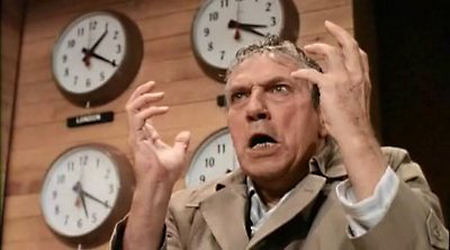
Of course, this is just me being partisan again. I sometimes imagine a modern-day John the Baptist to be like Howard Beals, the fictional news anchor in the 1976 film classic Network. In Paddy Chayefsky’s satire of the television industry, an aging newsman goes berserk on camera and calls for Americans to open their windows and scream “I’m mad as hell, and I’m not going to take it anymore!” The character of Beals goads his viewers out of their torpor of avoidance and demands that they feel something about the state of the world. Unfortunately, raw passion alone—without the proper direction—soon reverts back into complacency. We can be ready to change, but the change has to be towards Jesus.
Image result for network 1976 film
Peter Finch as Howard Beals in "Network" (1976)

So where is our passion today? Do you think we’re really ready to receive Jesus? Or are we stuck in finding Black Friday bargains, closing our borders and our minds, or just shutting off the news and pretending that sin in our world just doesn’t exist?

How will people be ready to receive the Good News Jesus has to deliver? Who will be the advance man?

Do you think it could be YOU?


God’s peace, my friends. Thanks again for reading.

Sunday, November 27, 2016

Reflections on Advent


You also must be ready, for the Son of man is coming at an unexpected hour.” (Matthew 24:44)

The above passage from Matthew’s gospel, the line which ends the first gospel lesson for Advent One in Lectionary Year A, is a pretty ominous verse. Jesus is coming, and we don’t know when. He might just catch us by surprise. I mean, what if you’re in the shower or gambling in Vegas or doing something you might be ashamed of? What if you’re busy having a feud with your in-laws or yelling at your kids when Jesus suddenly shows up and says, “Time’s up!” How would you feel? Or maybe you’re busy doing something really fun? Maybe you’re at your kid’s soccer game when the End of the World comes. How would you know who won?

I’m not really sure that most of us give much thought to Jesus’ return. And yet, every year at Advent we begin the Prayer of the Day with the words “Stir up your power, Lord Christ, and come.” Maybe we’re just having too much fun without the Second Coming. Still, the older I get, the more I understand how our lives are always about waiting for something wonderful to happen.

Think about it. When you’re a kid, you just can’t wait for Christmas (although, I suspect we are waiting more in the spirit of greed for toys and goodies than we are waiting to hear about Baby Jesus!). As we get older, we just can’t wait for adulthood—for our driver’s license, our high school graduation, or our journey to college when we’ll be free at last of our pesky parents—never suspecting that they’ve been waiting to be free of us for a little while, too.

As adults, we still find ourselves standing in the line of time and circumstances. We’re waiting to find that special someone who will give our lives joy and purpose. We wait to get married and we long for the moment when we say “I do.” Of course, sometimes waiting for a wedding is mixed with both excited longing and intense anxiety depending on how much of a perfectionist the bride—or her mother--is. In that case, we just can’t wait to get it over with!

Then we’ll wait for a better job, for our children to be born, for a special vacation, a raise, a new house, or retirement. We wait for that magical season when our favorite local sports team wins the championship (some wait longer than others!). Sometimes the waiting is much more special than the actual event. When I graduated from seminary, I waited excitedly for my ordination. When the event finally arrived, I was so stressed out by the arrangements I’d made I realized I wasn’t even paying attention to the service.

Sometimes, we find ourselves with our loved ones gathered around a bedside, waiting for someone we love to leave this world. Those times feel like the waiting goes on forever.
           
Sometimes we wait, as the song says, for the world to change.

Do we ever, I wonder, really wait for Jesus? If you do, what does that mean to you? It seems like everything else for which we wait passes into memory after it occurs, and we go on waiting for something new. Yet nothing seems to satisfy us enough for us to say, “My waiting is over. I just want to be in this moment forever.”

When Advent comes, I always try to take some time to ponder what it means to wait upon the Lord. Like everyone else, I look forward to those candlelight liturgies, to singing the Christmas carols, to giving gifts, and having Christmas Day dinner with my family. And yet I know that these annual rituals are just the foretaste of the feast to come which will put an end to all waiting. And I long for that. The little baby, child of an unwed teenager, born homeless in a stall for animals, lovingly ogled and cooed at by dirty sheep-herding peasants, came to remind us all that the day will come which will put an end to waiting. We will have peace. We will know we are loved. We will want no more and hunger no more. We will sin no more, hate no more, hurt no more. Wait no more.

In the meanwhile, believing that God’s promise is true, we wait in confidence, and the waiting is both bearable and lovely.

A blessed Advent and Christmas to you all.