Saturday, September 6, 2014

Jason & Doug's Wedding Homily


John 15:9-12


As the Father has loved me, so I have loved you; abide in my love. If you keep my commandments, you will abide in my love, just as I have kept my Father’s commandments and abide in his love. I have said these things to you so that my joy may be in you, and that your joy may be complete. This is my commandment, that you love one another as I have loved you.


You guys!

Yeah. I have to admit it: this is a very special day of celebration for me and for this congregation as well as for the two of you. You are Faith Lutheran's very first same-gender couple to be legally married—not only in the eyes of God and of this community of friends and family—but in accordance with the laws of this commonwealth. This day is long overdue, and we rejoice that it has come at last. It's a celebration of your love for each other, of our society's recognition that you have a right to live out your love honestly and openly, and of this congregation's love for the two of you.

Gotta be honest here. Although I was really delighted to have you lads join Faith two years ago, I wasn't exactly sure how to represent you to the congregation. I didn't want to point at you and say, “Here's Jae and Doug, our token gay couple!” It wasn't that I thought I'd get any backlash from the folks here, it was that I didn't want you to be just “those gay guys.” I figured that if I didn't say anything, eventually these clever Lutherans would figure it out. And they did.

And they decided that they loved you. Jason, your enthusiasm on the Praise Team warmed the hearts of retired choir ladies. And Doug, your willingness to help out with Sunday School made you a favorite with our teachers and parents and our kids. Your anti-bullying workshop was beautifully done and truly appreciated. This congregation saw new, young Christians who were willing to form community, volunteer their time for Interfaith Hospitality Network, serve on Sunday School and the church council, and lend a hand whenever a hand needed to be lent. You walked the walk, and as your pastor, I want to tell you how much I appreciate what you've done and continue to do for Faith.

But there's something else. From the time you came here, a change started to come over this congregation. You guys are two of the most genuinely loving human beings I've ever had the pleasure to know, and, somehow, your gentle spirit has started to effect this place. We've been better people since you've been here. I can't explain it, but we have. And I love you for that.

Love. That's really what today is all about.

In the gospel lesson for this service, Jesus tells the ones he loves to live and breath and move and have their very beings in the love that comes from obedience to God's law. And what's that law? Basically, the Ten Commandments just boil down to this: love God, and love everyone else. But Jesus exhorts us to love as he has loved us. And that might be a pretty tall order.

Here in the fifteenth chapter of John's gospel, Jesus has just taken the servant's job and washed the feet of his disciples. He's loved them by serving them. As a married guy, I think I can testify that a little foot rubbing from time to time can go a long way towards strengthening a relationship. But it's more than just that. Today you're being called upon to confess that you will love each other as servants—each putting the needs of the other before his own, each subjugating his own ego.

You see, to love as Jesus loves means to be willing to sacrifice. Jason, you have to give up a little bit of your need for reassurance and control. Doug, you'll have to give up taking things for granted. You'll both need to carry your cross, remembering that you can only be responsible for your marriage to your partner, you can't control your partner's marriage to you. You will require faith, hope,and love.

Now, I know you love each other. In fact, you've told me it was love at first sight that day Doug wandered into the AT&T store. You guys just knew. Three months later you were living together, and you've made it work for the last five years. So for the next fifty years, let me give you a bit of advice:

In the old Anglican Book of Common Prayer the marriage vows used to contain the phrase, “With my body I thee worship.” Think of Holy Matrimony as a worship service. It must include praying together. It must include praising—both God and each other. And it must include the element with which we begin every mass—daily confession and absolution. If you can't learn the phrases, “I'm sorry” and “I forgive you” and really mean them, you can't be married.

And remember, too, that St. Paul taught us that while we were yet in our sins, Christ died for us. He didn't wait to sacrifice himself until we were perfect or until we deserved it. We have to love others in their sins just as Christ loved us in ours.

My prayer for you is that you will always love each other courageously for your weaknesses as well as your strengths. Thank you, again, for being who you are, and may the peace of God which passes all our understanding keep your hearts and your minds in Christ Jesus. Amen.

Thursday, September 4, 2014

Reconciled in Christ (Reflections on Pentecost 13)


Reconciliation. That's the theme for worship on the Thirteenth Sunday after Pentecost in the Revised Common Lectionary. For lots of churches, this Sunday is, as we at Faith Lutheran of Philadelphia call it, “Welcome Sunday.” It's the day of family reunion when summer travelers return to the pews (we hope!) and kids return to Sunday School. It's a day of getting folks together to celebrate.

Recently, we've had a quite a bit of festiveness at Faith in celebration of the first same-sex wedding held in our congregation. This was a pretty big deal for a little blue-collar church. Some time back, the Evangelical Lutheran Church in America began to use the term “Reconciled in Christ” for congregations which were welcoming to same-gender oriented people. Certainly, if nothing else, the Church should be a place of reconciliation, but I noticed when I worshiped at “Reconciled in Christ” congregations back in California that these parishes tended to become “the gay church.” Reconciled in Christ looked an awful lot like Segregated in Christ.

Similarly, on our last Welcome Sunday we welcomed our “renter” congregation, the Beth-El Church of God in Christ, to join us in worship. Their wonderful pastor, The Reverend George Nash, preached a sermon so orthodox that Martin Luther himself could have written it. Still, I seemed to detect a small amount of squeamishness when Beth-El's choir took to the chancel and began to worship in the manner consistent with their African American Pentecostal tradition. There just seems to be something about this which makes middle class white Lutherans a little uneasy.

Dr. Martin Luther King, Jr. is often quoted as saying that Sunday morning worship time is still the most segregated hour in America. Perhaps it's a good thing that today's lessons (Ezekiel 33:7-11 and Matthew 18:15-20) focus on our responsibility to our neighbor and Christ's desire to see hearts corrected and brought back into the fold. It is the Church's responsibility to bring folks together, black and white, gay and straight, and all other shades and varieties. Yes, it's been a pretty tough order for most of our history, but that fact shouldn't keep us from trying.

I love the fact that Jesus' instructions on reconciliation in Matthew's gospel is the model which ELCA constitutions use to correct erring church-goers. Once in my ministry I had to resort to these instructions, and I'm happy to report that they proved practical. Jesus seems more concerned about reclaiming a family member than punishing a discipline problem. That's the spirit in which Christians need to approach all schisms, differences, and disagreements. We need to ask, “What do we have to do to bring people together when they are hurting and injuring each other?”

I know. Sometimes we just can't get reconciled with people who don't want to be reconciled. If you're like me, the news of two American journalists, James Foley and Steven Sotloff, brutally beheaded by the radical Islamic group called ISIS does not make me want to go out and kiss a Muslim. I'm also all in favor of doing justice and punishing the wicked. But I want to be careful about the spirit in which I approach it. Hatred only breeds hatred. A desire to be a victor will have to make someone else a victim. There must be a better way.

I feel a little less powerless, however, when I read in The Lutheran magazine about the work the Lutheran World Federation is doing to aid the victims of the war in Gaza. The LWF's Augustus Victoria Hospital on the Mont of Olives in Jerusalem has Christian, Muslim, and Jewish staff all working together for humanitarian goals. Somehow, this institution has broken through the walls of segregation and reconciled people of three different faiths. It can be done.

Jesus promises us in this pericope that whenever we agree with each other, we have God's blessings for success. Even Gentiles and tax collectors were not locked out of Christ's compassion and grace. Let's accept the challenge to correct in love and keep striving for togetherness.
Thanks for visiting, my friends.

Augustus Victoria Hospital on the Mount of Olives, a place of reconciliation.


Wednesday, August 27, 2014

"Get Behind Me, Satan" (Reflections on Pentecost 12)


From that time on, Jesus began to show his disciples that he must go to Jerusalem and undergo great suffering at the hands of the elders and chief priests and scribes, and be killed, and on the third day be raised. And Peter took him aside and began to rebuke him, saying, ‘God forbid it, Lord! This must never happen to you.’ But he turned and said to Peter, ‘Get behind me, Satan! You are a stumbling-block to me; for you are setting your mind not on divine things but on human things.’ Then Jesus told his disciples, ‘If any want to become my followers, let them deny themselves and take up their cross and follow me. For those who want to save their life will lose it, and those who lose their life for my sake will find it. For what will it profit them if they gain the whole world but forfeit their life? Or what will they give in return for their life? ‘For the Son of Man is to come with his angels in the glory of his Father, and then he will repay everyone for what has been done. Truly I tell you, there are some standing here who will not taste death before they see the Son of Man coming in his kingdom.’ (Matthew 16:21-28)


Yikes!


When we last left our heroes Jesus and Peter last Sunday, Jesus was being pretty complimentary to Peter for figuring out (with the aid of the Holy Spirit since Pete's not swift enough to come up with this on his own) that Jesus is the Messiah and the Son of the Living God. This Sunday, however, our gospel from the Revised Common Lectionary has Peter totally misreading the situation and coming in for a royal butt-chewing from Jesus. If you're anything like me, you'll have to admit that Jesus is the very last person you'd ever want to give you a dressing down—even though every last one of us deserves one (and if you don't think you do you're kidding yourself!).


Peter just doesn't quite get what it means to be the Chosen One of God. It's not about power, fame, prestige, wealth, or any of those earthly things. Jesus tells his disciples to carry their cross. That is, they are to be prepared to suffer for the sake of the gospel. I've heard it said that the cross we're called to carry might not always be our own. This is no injunction to suffer in silence for those who are being crushed beneath the weight of poverty, loneliness, violence, or other oppressions. Just as Simon of Cyrene picked up Jesus' cross when the Lord could bear it no longer, so we in the Church are constantly called to shoulder the cross of others' suffering. But lots of times there are things which get in the way.


Yeah, I agree it might sound a little harsh for Jesus to call Peter “Satan.” To us, this title conjures up images of a nasty little red dude with a forked tail and horns. Very unflattering, don't you think? However, in Jesus' time, “Satan” might have meant just the same as it did in the book of Job. A “Satan” was an inhibitor. In Job, Satan does God's will by blocking Job's prosperity. Although I'm certain he believed in the medieval notion of a demonic creature, Martin Luther located evil not only in the devil, but in the culture and in our own selfish nature (see explanation to the Sixth Petition of the Lord's Prayer in The Small Catechism).


Perhaps dear Peter is falling victim to a culture which only values power, wealth, and prestige? Doesn't our own world inhibit us from our purpose of cross-carrying at times? Some months ago I wrote a post about the Canadian actress Ellen Page when she spoke at a Human Rights Campaign's “Time to Thrive” event. I applauded Miss Page for speaking out against the expectations of the culture which draw young people away from their true selves. It seems that Miss Page had been advised to hide the fact that she is gay from her public for fear that such a disclosure would jeopardize her film career. Nevertheless, she made the bold decision to introduce herself for who she really is, a decision which doubtless gave courage to countless other young people. Similarly, she warned her audience about a culture which preaches the virtues of being beautiful, thin, wealthy, and perpetually young (and probably in possession of the fanciest new electronic device as well!).


The values of the world, coupled with our own insecurity about being worthy, are stones in the road of our true purpose. Sometimes I wonder if, as the Church, we value huge worship attendance, sumptuous sanctuaries, doctrinal purity, and community prominence more than we value mission to the gospel of Jesus Christ.


This gospel reading calls us to cast ourselves in the role of Peter and ask what Satans are keeping us from God's purpose. What lie are we chasing which keeps us from being authentically alive in our relationship with God? How do our own expectations or desires stand in the way of what God wants for us and for the world?


I don't know about you, but I catch myself being a stumbling block all the time. Sometimes I need a lesson like this reading to remind me that all of the earthly glories—praise, authority, prestige, possessions—will all cease to be of value when I'm dead. I'll only find my eternal value in the cross of Jesus.


Thanks for reading, my friends!


Wednesday, August 6, 2014

Spinning Plates (Reflections on Pentecost 9)


Sometimes I feel like that juggler dude who used to be on the Ed Sullivan show back in the sixties. You know the guy I mean? The one who used to spin plates on a stick..? He'd put these dinner plates on the tops of really thin dowels and spin them like Frisbees and they'd keep spinning, except that he'd have to keep running back and forth from plate to plate to keep them all up in the air at the same time. Is your life ever like that?

Summers in a small urban church are pretty sleepy, and there's not always a lot of work for a pastor to do. I visit the homebound, of course, but I don't have to prepare for special services, supervise projects, or do lesson plans for confirmation classes. Even the volume of neighborhood funerals seemed to be slowing down a bit and then...WHAM! Suddenly all the plates start spinning at the same time and I have to keep them all in the air. I'm trying to plan a vacation, but family members start having health problems which need pretty earnest attention. There are doctors' visits to be scheduled and procedures to be undergone and days to be re-arranged. Then a long-time member of the congregation decides it's time to find herself hospitalized in an end-of-life situation, and her family needs the pastor to discuss terminating care. I find myself spending two mornings with the anxious relatives at the local hospital. Now a funeral service must be hastily arranged around medical appointments and vacation time. The bereaved family must be visited, the congregation notified, the homily written, and a worship bulletin prepared. Of course it's at this time that my car needs to go into the shop and the dog needs a trip to the vet. Suddenly it's the congregation's turn to host two displaced families in the church basement in partnership with Interfaith Hospitality Network, and volunteers must be cajoled, schedules made, and re-made, and changed again as three church committees decide they must have meetings which the pastor must attend during the same week while the church newsletter deadline is moved up to accommodate the vacation and the phone begins to ring off the hook as a thousand things suddenly demand all of my attention and my wife wonders why I spend so much time at work.

My brain has been a strangely noisy place lately.

That's why I so love the lessons in the Revised Common Lectionary for Pentecost 9. In the Hebrew scripture lesson from 1 Kings (1Kngs 19:9-18) we find the prophet Elijah living in a cave on Mt. Horeb. He's pissed off with God and Israel and feeling at the end of his rope. He's just defeated 450 prophets of Baal, and it hasn't made a dent in the political situation. He's on the run and in a pretty bad mood. So God tells him to get out of the cave and just wait. Then there's a hurricane. Then an earthquake. Then a forest fire. Then nothing.

And in the nothing, God.

Elijah's just like us. There's chaos and weirdness all around him. But that's not where God is. God is found in the stillness—the stillness that's in the very midst of the hullabaloo.

For someone like me, it's pretty hard to find the stillness, to listen to the sound of the silence, and to remember that it's all about God and not about me. But I think I can do it. I can find Jesus walking in the middle of the swirling tempest, and know that he's come here for me. If I keep my focus on him, I won't sink.

Find some quiet time, my dears. Breath. I assure you, it will all be alright.

Thursday, July 31, 2014

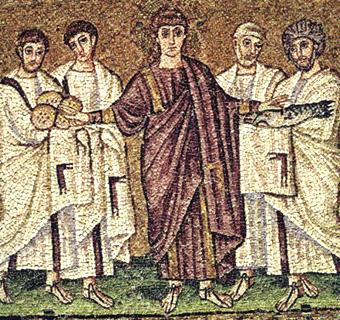
The Miracle of the Loaves and Fishes (Reflections on Pentecost 8)


I totally get where Jesus is coming from in this Sunday's gospel lesson. Of course, when you read this story you have to understand what came just before it. Jesus' cousin, John the Baptist, has just been beheaded by King Herod. Keep that in mind when you read:

Now when Jesus heard this, he withdrew from there in a boat to a deserted place by himself. But when the crowds heard it, they followed him on foot from the towns. When he went ashore, he saw a great crowd; and he had compassion for them and cured their sick. When it was evening, the disciples came to him and said, ‘This is a deserted place, and the hour is now late; send the crowds away so that they may go into the villages and buy food for themselves.’ Jesus said to them, ‘They need not go away; you give them something to eat.’ They replied, ‘We have nothing here but five loaves and two fish.’ And he said, ‘Bring them here to me.’ Then he ordered the crowds to sit down on the grass. Taking the five loaves and the two fish, he looked up to heaven, and blessed and broke the loaves, and gave them to the disciples, and the disciples gave them to the crowds. And all ate and were filled; and they took up what was left over of the broken pieces, twelve baskets full. And those who ate were about five thousand men, besides women and children. (Matthew 14:13-21)

Having just lost a beloved relative myself, I understand how Jesus would just want to get in a boat and spend a little time on his lonesome to sort stuff out. Unfortunately, the neediness of people doesn't go away just because we're not feeling in the pink, and needy folks have no sense of boundaries. I'm sure Jesus would've loved to tell the crowd, “Sorry, guys, but I'm not really myself today. My cousin just got his head cut off by a blood-thirsty despot, and I'd really like to take little more time off.” But that's not quite Jesus' style.

Jesus knows that no matter how much we give of ourselves, God's generosity is so great that we will always be able to go one step further. The scripture says he had compassion on the crowds, and he started to heal their sick. I'm sure this took some time, and I have to give props to the disciples for recognizing that the crowd was going to need to get something to eat. That was very compassionate of them. BUT, when they take their concern to their boss, Jesus does an uncharacteristic thing. He throws it back on them to address the hunger situation.

Compassion, of course, is all well and good, but if it isn't married to some kind of genuine action it isn't worth a thimble of warm spit. The disciples balk, telling Jesus that their own resources aren't sufficient to handle such a huge issue. Jesus tells them to surrender their lunch pail anyway.

Lots of people speculate that you can explain the miracle of the multiplied food by saying one act of generosity gave rise to others—suggesting the disciples' sharing encouraged others to share their resources. Maybe that's so, but for my money the original miracle was the act of faith by which the disciples were willing to part with their own provisions in the hope of aiding others. Discipleship centered on Christ's love overcame fear of privation. That's pretty impressive.

As a parish pastor I deal with the fear of scarcity all the time. After almost sixteen years in an urban congregation I've begun to recognize that the precipice of fiscal doom is our natural habitat. We live on the edge of faith and hope all the time. And because there is a hurting world out there in need of Jesus' compassion—because we who are in Christ also feel this compassion—we commit ourselves to surrendering what little we have to doing the work of God's love.

I no longer care what people are giving to the church. I care more about why they are giving. I don't care about institutional survival. I'm much more interested in knowing that we are living out the gospel.

Let the miracle be in us.

Thursday, July 24, 2014

Who Are You? (Reflections on Pentecost 7)


A weird thing has been happening with this blog lately. It seems that a post I wrote back in January called “Fishing Sucks” has gone—well, if not exactly viral—at least somewhat bacterial in Ukraine. The post was a reflection on the gospel for Epiphany 2 in which Jesus encounters the fishermen Peter and Andrew and James and John and calls them to leave their nets and follow him. The story challenges us to ponder just what it is about Jesus which inspires such a radical change of heart that fishermen are willing to be transformed into “fishers of men.” I guess that the change of identity resonates with our Ukrainian brothers and sisters as recent events in that country have forced them into something of an identity crisis. Are they Ukrainians or Russians or what? Whatever they may be, they are certainly standing in the need of our prayers, so please don't forget them.

BUT: The gospel in the Revised Common Lectionary for Pentecost 7 (Matthew 13:31-33, 44-52) is also, I think, a challenge to our identity. It's asking us, “Who are you?” I mean, if you were suddenly to lose your nationality, or your job, or if you could no longer indulge your hobby and hang with your friends, if you lost all possessions and social standing, or if your family situation changed so that you were no longer a husband or wife or mother or father or child or sibling, if it came to pass that you weren't even a Lutheran any longer, who would you be?

Wouldn't you still belong to Jesus? Wouldn't you still be God's child? Isn't that who we are at our very core?

He put before them another parable: ‘The kingdom of heaven is like a mustard seed that someone took and sowed in his field; it is the smallest of all the seeds, but when it has grown it is the greatest of shrubs and becomes a tree, so that the birds of the air come and make nests in its branches.’ He told them another parable: ‘The kingdom of heaven is like yeast that a woman took and mixed in with three measures of flour until all of it was leavened.’ (Matt. 13:31-33)

Our relationship with Jesus may seem like a tiny portion of our busy and multi-faceted lives; however, that one relationship changes and informs everything we do and everything we are—just as the little seed grows into a huge shrub or the pinch of yeast causes the whole loaf to rise. It's the knowledge and conviction that once a man loved us so much he was willing to be tortured to death on a cross for our sake. It's the resurrection faith that tells us we are heirs of eternity. It is the inspiration which constantly calls us to live lives of loving service in grateful response to God's goodness and mercy, giving us a sense of purpose and meaning.

The kingdom of heaven is like treasure hidden in a field, which someone found and hid; then in his joy he goes and sells all that he has and buys that field. Again, the kingdom of heaven is like a merchant in search of fine pearls; on finding one pearl of great value, he went and sold all that he had and bought it. (vv. 44-46)

In the 1991 comedy City Slickers (Okay. I apologize for using movie illustrations two posts in a row, but I really like this flick!), an old cowboy tells a younger city dude that the secret of life is one thing.
City Slickers (1991): A Modern

You get that right,” the old-timer says, “and the rest don't mean sh--.”

The younger man asks him, “But what's the one thing?”

That's what you have to find out,” the cowboy says.

But we don't have to find anything. God has found us. For Christians, the one thing, the treasure, the pearl of great value, is Jesus. If Jesus, who walks with us in all of our pain, who promises us eternal life, and who shows us forgiveness, compassion, and healing, is at the center of our identity, everything else in our complicated lives will fall into place.

How cool is that?


Thursday, July 17, 2014

Spare the Weeds (Reflections on Pentecost 6)


There's a great scene in the 1939 Ernst Lubisch comedy Ninotchka. Greta Garbo plays a Soviet envoy who has come to Paris on a diplomatic mission. The dour bureaucrat is greeted by three fellow communists at the train station who ask her, “What is the news from home, Comrade?” Garbo, with a brilliantly dead-pan comic delivery, responds, “Wonderful news, Comrades. The last mass trials were a great success. There are going to be fewer but better Russians.”
Film ninotchka.jpg


Of course, the audience in 1939 understood this line as a darkly humorous jab at the violence of the USSR under Joseph Stalin. The dictator's recent “purges” had led to the execution or incarceration of countless Soviet citizens on the grounds that they did not adhere to the purity of Communist Party doctrine.

But is there ever anything really “pure” in this sinful world? The history of the Christian Church might be just as notorious as Stalin for trying to “pull the weeds.” Whether it was the Holy Inquisition or the mass defection from the ELCA following the 2009 Churchwide Assembly, we Christians have usually done ourselves more harm than good when we've tried to separate the evil from the good.

Jesus' parable of the “Wheat and the Weeds” (Matthew 13:24-30, 36-43), which serves as our Gospel lesson for the Sixth Sunday of Pentecost, must have been quite a shocker to the early church. It's pretty much accepted that Matthew's community was living under persecution. When the heat was on, some of those first Christians sucked it up, stood firm, and suffered the consequences of being part of an outlaw religion in the first century of the Common Era. Others may have equivocated a bit. I wouldn't doubt that the ones who suffered were pretty disappointed with the ones who chickened out. Nevertheless, the parable taught them that it was not their place to judge who did or did not belong to Christ's church. It's not our place, either.

I'd like to point out that, in my research, I noticed the smart old boys of the Jesus Seminar (those clever professors who are always trying to figure out which sayings in the gospels are legitimately the words of Jesus and which were added by the evangelists) don't believe that Jesus really gave the disciples the allegorical interpretation of this parable found in verses 36-43. They suggest that this explanation may have been added later to address the situation in Matthew's community since it doesn't appear anywhere else in the gospels. Okay. I'm cool with that. I think Matthew's interpretation is just as valid as any other. Basically, he's telling us that Jesus says it's not up to us—puny, myopic, mortals—to declare who or what is good or evil in this world. Such an explanation opens the parable up to a whole bunch of new allegorical situations.

Think about it: Can you “weed out” the good and evil times in your life? Would you really want to? When you consider all the crap you've been through, didn't it make you a wiser, more mature, and stronger human being? If you could avoid all of the hard times, difficult relationships, tough choices, and suffering—would you really be living? Wouldn't you be pulling the wheat out with the weeds?

Or think about the people God has placed in your life. I consider my own parents. To be honest, my “Greatest Generation” folks had a few flaws. Chiefly—and how shall I put this?—their views on race, particularly as pertaining to African Americans, were somewhat less enlightened than I would wish them to have been. Nevertheless, these were the people who took me to church, taught me the gospel, and raised me to be a responsible adult. I can't discount them in totality because of their deeply flawed opinions in one area—however wrong these opinions certainly were.

Sometimes, we just have to let the weeds grow with the wheat. We can't condemn an entire life because of a weak moment. We can't lock our hearts away because we fear being scorned or abused. We can't give up on the faith because some ignorant and arrogant people have called themselves Christians. It is a very lucky and merciful thing to realize that we are not  called to be the gardeners of our own lives.


God bless you, my fellow weedy sinners. Thanks for dropping by!