Wednesday, August 21, 2019

Jesus Heals on the Sabbath (Reflections on Pentecost 11, Year C)


So Jesus heals on the Sabbath? Good. That’s what the Sabbath is for, isn’t it? The stuffy leader of the synagogue in the Gospel lesson appointed for Pentecost 11, Year C (Luke 13:10-17) seems to have missed the memo. He quotes only part of the Third Commandment as it appears in Exodus: “Six days you shall labor and do all your work (Ex. 20:9),” but he leaves out the whole rationale for the rule in the first place:

“But the seventh day is a Sabbath to the Lord your God; you shall not do any work—you, your son or your daughter, your male or female slave, your livestock, or the alien resident in your towns. For in six days the Lord made heaven and earth, the sea and all that is in them, but rested on the seventh day; therefore, the Lord blessed the Sabbath day and consecrated it.” (Exodus 20:10-11)

Get the point? The Sabbath is for rest. Rest restores and heals. It’s necessary. Ever go without sleep? Ever deal with something that was so relentless you couldn’t catch your breath? Sucks, doesn’t it? We need the rest. Our souls need it as well as our bodies. The Sabbath is God’s gift so we can be healed. Nothing should be more natural in the world than that Jesus should see the woman who is in slavery to her affliction, and—without her even asking for it—he calls her over and makes her whole. That’s what the Sabbath is for.

Granted, over the years we Christians have made Sundays as dreary and burdensome as the synagogue leader who gives Jesus a hard time in our Gospel story. In one of my favorite novels, Of Human Bondage, W. Somerset Maugham describes a dreary English Sabbath in which a young boy must suffer through interminable Anglican liturgies in both the morning and evening, interrupted by a monotonous Sunday afternoon in which all activity ceases and an oppressive edict of silence is imposed on the household. It’s shear Purgatory. And it was supposed to be good for the soul.

For me, however, the Sabbaths of my youth were always very pleasant times. I got to see my buddies at church, the folks were friendly, the singing and preaching were joyful, and there was always—even well into my adulthood when my siblings and I had moved out of the family home—family time. We’d gather around the dining table in my parents’ home or at a local restaurant. We’d get caught up. We’d talk about the service we’d just attended or whatever else. After Sunday dinner there was our traditional Sunday snooze. I think the whole clan would hit our bunks and doze off until it was time to watch 60 Minutes. The Sunday afternoon nap was as much a part of Sunday as church and dinner. Even when I went away to graduate school, I pretty much kept up our Griffiths family Sabbath routine.

But today, it’s different for a lot of folks. There’s no rest on the Sabbath. Some people have to hold down more than one job to make ends meet. Sales clerks and waiters don’t get their weekly schedules until the last minute, so they can never commit to weekly worship. The “gig” economy has people working seven days, or so dog tired on a Sunday morning that all they can do is stay in bed. America—once home of the “blue laws” which forbade businesses to be open on Sunday mornings and forbade the sale of alcohol on the Sabbath—has effectively killed the Lord’s Day of Rest.

So, okay. The Sabbath doesn’t have to be a specific day. When I was in seminary I knew a Lutheran pastor from Tanzania who had a seventeen point parish back in his home country. It didn’t matter what the calendar said. Whenever Pastor arrived in the village, that day was Sunday.

Martin Luther interpreted obedience to the Third Commandment as hearing the word of God and learning it. This could be done during a lunch break at Walmart or before a shift at the Taco Bell. I think what’s necessary for the Sabbath is not the liturgy or the trappings of a church building (as much as I love these things), but the quiet moment to come to the Word and know that you are loved and valued. If you can couple that with the fellowship of other believers—with your Christian “family” in whatever form they take—and find a few restful, peaceful, healing moments to do it, so much the better.

A Good Sabbath to you, my friend. Thanks for dropping in.
Wednesday, August 14, 2019

It's Not Always Good to be Nice (Reflections on Pentecost 10, Year C)


Everybody is saying it: we live in a divided nation. Folks in America have really strong—but really divergent—views on how this country should be run and what rules we should live by. People get so worked up they almost come to blows. At my neighborhood community center they’ve gone so far as to adopt a standing rule that no one may discuss politics on the premises. We just want to keep everything nice and friendly. We are, after, all a “55 and Over” community. No one wants to see geriatrics try to body slam each other over immigration policies or gun control.

But I’m not sure if “nice and friendly” is the way we need to go right now. In the Gospel lesson for Pentecost 10 (Luke 12:49-56), Jesus says:

“Do you think that I have come to bring peace to the earth? No, I tell you, but rather division.” (v. 51)

This may not sound like the sweet Prince of Peace with the lamb on his shoulder we see in stained glass windows or in our kids’ Sunday school books, but it sure sounds like the Jesus who entered the Temple of Jerusalem and drove out the guys who were ripping off the poor.[i] Jesus wasn’t afraid of sowing a little division where the truth was concerned.

Saint Paul also reminds us that division can be a good thing:

“Indeed, there have to be factions among you, for only so will it become clear who among you are genuine.” (1Cor. 11:19)

Yes, Christians should be friendly, welcoming, peace-making, and nice. But, quite frankly, I’m a little tired of “nice” these days. When innocent people keep getting gunned down in places like El Paso and Dayton, I think it’s time to do away with “nice.” In fact, I think it’s time to scream our heads off, and if people don’t agree, that’s just too friggin’ bad.

It’s now been twenty years since the shooting at Columbine High in Littleton, Colorado. Since that time acts of mass gun violence have only increased. Decency and regard for public safety demand that our lawmakers enact some kind of gun control legislation. This needs to be shouted so loud that even the dimmest sycophant of a politician sucking at the NRA’s teat can get it through his head. There are common-sense measures which can be voted on if our elected representatives have the guts to make them law:

1.      No American civilians need an assault rifle. These weapons should be outlawed along with high-capacity magazines, bump stocks, etc.
2.      There needs to be a federal law standardizing background checks for all gun purchases which includes a mandatory waiting period.
3.      We must outlaw the direct or immediate sale of guns at gun shows and through the internet. All dealers must take responsibility for the firearms they sell.
4.      We must strengthen domestic violence and “red flag” restrictions on gun ownership.

If ever there was a time to start sowing division, it is now. I’m sick and tired of people who only want to come to church to feel good. If you want to feel good, get a massage or watch an episode of Modern Family. Don’t expect that the Gospel of Jesus Christ will always be a comforting thing. Jesus came to shake things up.

Nothing makes me as spitting angry as hearing Evangelical televangelists assure us that we’re good Christians as long as we’re not gay or transgender, don’t have abortions, and give unquestioning loyalty to the Israeli government (no matter how much that government oppresses Palestinian Muslims and Christians). I want to ask these millionaire preachers how they can rant about the things they rant about while many Americans are living below the poverty line and don’t have decent healthcare.

I don’t want to hear platitudes from the—what is it now?—eighty-five or so Democrats who think they want to be president. I want a real Christian voice to rise up like Martin Luther risen from the grave and call out these hypocrites for their hypocrisy in the name of the Lord Jesus Christ as revealed in the Scriptures. And if that causes division, so be it.

We are called to be followers of Christ. Christ called out the money changers and the hypocrites. He caused trouble. So did Martin Luther and Martin Luther King. So does Pope Francis from time to time. We have to ask ourselves if it’s right to be silent and nice in the face of racism, xenophobia, and just plain bad public policy.

“Nice” isn’t nice if it masks the truth.


[i] Matt. 21: 12-13, Mark 11:15-17, Luke 19:45-46, John 2:13-17

Thursday, August 8, 2019

It Ain't Over (Reflections on Pentecost 9, Year C)


Image result for images of stars in the sky
This month a bunch of my former confirmands will be heading off to college. I’m always amazed by how quickly the young stop being quite so young. I look at these young men and think it was only yesterday they were goofy-looking fourteen-year-olds. Now they’re tall, handsome young adults who still have the glorious adventure (and misadventure, too!) of their whole lives ahead of them.

Remember when you were that age? Life seems a little less adventurous now, doesn’t it? I’m staring down the barrel of the Big 6-0 and I’m pretty sure I’m not going to get any better looking from here. I’m probably not going to get any more physically fit either. For that matter, I have serious doubts I’ll ever make a fortune or become world famous or run a marathon. Nope. Those ships left port a long time ago. It’s all pretty much downhill at this point.

Do you ever feel like Abram in the First Lesson appointed for Pentecost 9 this year (Genesis15:1-6)? You start to think about old age and death and all the cool stuff you may have missed out on and you wonder if you have anything to look forward to. Ever get like that? Poor Abram thinks God has forgotten the promise, but God gets Abe to see things in a different light. In this case, starlight. That’s a whole new perspective.

A few nights back I came home from a church council meeting and I took a few minute just to look up at the night sky and see the stars. I couldn’t count as many as Abram could in his day—what with light pollution from the city and all—yet I still found the sight astonishing. Those whirling balls of flaming gas are millions and millions of miles away; nevertheless their light still reaches us. The light we see left those stars millions of years ago. It almost makes your brain explode to contemplate the enormity of the universe. All I could think as I looked at the stars was, “How great is our God.”

In both the Hebrew and the Greek scriptures appointed for this Sunday in Pentecost, God’s people are given comfort and assurance. In this week’s Gospel (Luke 12:32-40) Jesus tells us, his “little flock,” to have no fear. The Kingdom is ours. It’s pretty reassuring to know that the God who created the vastness of the universe still has a blessing planned for us—even though we might think the final score is announced, the season is over, and all the players have hit the showers. It ain’t over ‘til it’s over, as the saying goes, and we’re enjoined to keep alert for what God has planned next.

Jesus’ first piece of advice is to forget about the material things (v.33). The older I get, the more I understand that stuff is just stuff. There’s so much we can do without. Don’t you think it’s much more satisfying to know that we’ve stewarded the blessings God’s entrusted to us for the benefit of others? Jesus tells us,

“Sell your possessions and give alms. Make purses for yourselves that do not wear out, an unfailing treasure in heaven, where no thief comes near and no moth destroys.” (V.33)

That’s something we can do at any age, right?

Jesus also tells us, just as the Father tells Abram, to keep watching and to be ready. The image he gives us, that of servants preparing for the return of the master, is an active image. We don’t just sit around playing Angry Birds on our cell phones and saying, “Gosh. Wonder when he’s going to get back..?” We’re supposed to be doing. There’s the fire to be lit and the table to be spread and the food to be prepared. There’s a house to be cleaned and snow to be shoveled off the walk and lamps to be lit outside. Jesus is urging us to look for the joy of God by being active.

What does that mean for you? I’d say a good start is by committing to spiritual discipline. My dentist told me I had to floss because my gums are getting too loose. If I give myself a good flossing one day and neglect to floss for a week, I’ll probably be on the road to a root canal. If I work out extra hard at the gym one day, and then don’t go for a month, the one-day workout won’t do me any good. I have to be consistent.

And so it is with our spiritual lives. Prayer is a daily activity we can do at any age. Worship is a weekly activity through which we keep learning and growing. Generosity is a habit which breeds wisdom in our lives. Fellowship with others and sharing our faith challenges us to examine our beliefs, gain understanding, and delight in the gift of each other’s company. To use Jesus’ metaphor, should a thief try to break in—illness, death of a loved one, loss of income, retirement, or anything that drastically changes our lives—we’ll be ready for him. We’ve prepared.

We have a really BIG God. We have a God who is calling us to keep looking toward tomorrow with hope. We have a God who keeps calling us out of ourselves to astronomical possibilities.

Keep looking up. God bless you!

Thursday, August 1, 2019

Storing Up Treasures (Reflections on Pentecost 8, Year C)


Image result for Images of piles of currency
Rich has been my buddy for almost forty years, even though he lives in Wisconsin and I only get a call from him every now and then. I have to say he has always been a rather frugal individual. He cuts coupons, shops at discount stores, likes “one-price-all-you-can-eat” restaurants, and—at least when he and I hung out together—would pinch a penny so hard Abe Lincoln would beg for mercy. Several years ago he was fortunate to find a young woman brave enough to marry him. I, knowing him as I do, was quite astonished when he announced his plans for a rather luxurious honeymoon. He and his lovely bride would travel to California and from there on to a tour of Australia and New Zealand. Rich described the adventure with great detail, but ended the narrative by plaintively moaning, “But it’s gunna cost me eight thousand dollars, Griff, and…well…you know me and money.”

I reassured him, “Dude, this will be the best eight grand you’ll ever spend.”

Boy howdy, do we ever hate to part with cash! I’m sure your parents always told you to have something put by for a rainy day. Save for your retirement. Save for your children’s college education. Save to buy a house. Save for an emergency. Save to have something for the kids when your time’s up. Save for the grandkids. Save for your funeral. Saving is prudent and wise.

But. Did you ever know anyone who saved all their life and forgot to live their life? Someone who wanted to have their cake but never eat it? That rather defeats the purpose of cake, don’t you think?

Face it, a lot of folks are like the man in the parable Jesus tells in Luke’s gospel appointed for Pentecost 8 in the RCL (Luke 12:13-21). We think if we build bigger barns and store up more wealth we’ll be able to live in comfort and security—as if comfort and security are the purposes of our lives.

Too often, I suspect, we as individuals and as the Church aim for comfort and security but miss out on our real purpose. That purpose is to learn and grow and be the healing presence of Christ in a hurting world. We do this both as individuals and as part of the Christian community. We’re called to trust that God, who has given us this opportunity, will provide us with resources both spiritual and physical. Money is nothing but a tool to accomplish our purpose. It’s not the purpose in and of itself.

It seems, however, that we never believe that our resources are enough. What I’ve seen in congregations (and I’ve seen three parishes in my conference go face down in the dust within the last nine months!) is a greater belief in scarcity than a trust in God’s abundance. They’ve circled the wagons, cut the costs, and figured out how long they can survive on dwindling savings and income. Now, call me reckless, but I just can’t see spending down endowment funds or savings just to put off an inevitable death of a community that wasn’t producing fruit for the Kingdom in the first place. I don’t know about you, but I’d rather go out in a blaze of glory than wither away whimpering.

God provides us with abundance to use for God’s glory. As families of faith we’re called to invest in meaningful and vibrant worship and in compassionate care and love for our communities. We are to be alive while we are alive, not sit quietly waiting for death. The challenge is first to realize that reliance on our own resources is an insult to God. Why? Because it denies God’s willingness to bless us.  Second, we should recognize that our wealth is not just in bucks in the plate or butts in the pews. God may have gifted us in ways of which we are not aware: talented people, visions for ministry, ability to serve children, space for community needs, or neighbors who would welcome a partnership. Additionally, we have to remember that we are called to be givers and not hoarders. If our fists are closed, nothing else can come into them.

I’m not suggesting that you or your congregation should go out and start spending hell bent for leather, but I would ask you to consider: What are you saving for? What kind of abundance do you already possess? To what purpose are you called? How are you investing in the things of God? By living in faith? By believing in God’s providence? By your generosity to others?

Rich and his wife had a great time on their honeymoon, and began their life together with a shared adventure which drew them even closer than they’d been before. I’m sure my friend has long forgotten the cost of his trip, but he’ll never forget having taken it.

Enjoy God’s abundance today, my friend, and thanks for looking in this week.

Thursday, July 25, 2019

A Lot to Pray For (Reflections on Pentecost 7, Year C)


Related image
“Shall not the judge of all the earth do what is just?” (Genesis 18:25)

Every family has that one (metaphorically speaking) anal sphincter in it. You know the guy I’m talking about. He’s the one who can’t get it together, who always screws up somehow, or who is always in need of getting bailed out for something. In the Hebrew Scripture lesson for Pentecost 7, Year C (Genesis 18:20-32) it’s Abraham’s nephew, Lot.

Lot’s not a really bad guy. It might just be that he’s a little selfish and has really bad luck. He decides to accompany his grandpa Tereh and his uncle Abraham on their first venture out of Ur of the Chaldeans. When old Tereh dies, it’s Uncle Abraham who lets Lot journey with him to the land that God has promised. When Lot’s herdsmen can’t seem to share ground with Abraham’s guys, Uncle Abe gives this kid and his posse their pick of grazing country. Lot—selfishly, if you ask me—chooses the best pasture land for himself (See Gen 13:7). But, hey! Abraham’s a good dude, and he trusts God. He figures he and his flocks and herds will get along just fine on the crappy land because he believes in God’s promise to bless him.

So Abe and Lot part company—for a while. For whatever reason, Lot gets out of the ranching business and settles in the town of Sodom. Sodom gets attacked by rebellious marauders, and Lot and his family are taken captive. Looks like Uncle Abe has to come to the rescue, so he gathers his 318 guys and attacks the marauders and rescues Lot (see Gen 14). After all, the guy is his nephew, and you have to help out your family, don’t you?

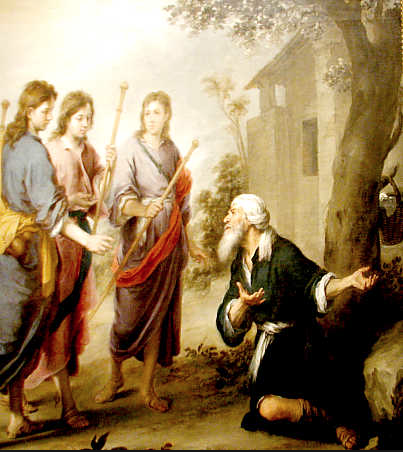
When we catch up with Abraham in the lesson appointed for Pentecost 7, he’s just been blessed by three strangers whom he correctly perceives to be the manifestation of Almighty God. These guys promise him (once again, because Abraham gets a little worried and doubtful from time to time—and don’t we all..?) that he will soon have his heart’s desire, a son and heir by his wife Sarah. Sarah, believing she is post-menopausal, gets a good chuckle out of this, but it turns out that the laugh’s on her.[i]

All’s well that ends well, right? But the kicker here is that the three divine strangers tell Abraham that they’re off to check out the wickedness of Sodom, Lot’s stomping ground. Abraham knows this can’t be good. If God is going to investigate a place for its wickedness, there’s a really good chance that place isn’t going to be around much longer. The Almighty might just nuke it, and Lot with it. So Abraham, once more pulling Lot’s chestnuts out of the fire, enters into some very obsequious negotiations with God. He dickers God down to an agreement to save the city for the sake of ten righteous people. I guess the upshot of the deal is that both Abraham and God agree it’s better to forgive the guilty than to punish the innocent.

(By the way: The great sin of Sodom and Gomorrah isn’t what some people think. God isn’t smiting theses cities because the inhabitants are gay. In fact, the rape suggested in chapter 19:5 and following might be better understood as a prison rape. That is, it’s committed to shame and dehumanize the victim, not out of sexual lust. The reception of the strangers in Sodom is contrasted with Abraham’s gracious welcome of them in chapter 18. The Sodomites are suspicious and treat strangers with contempt. Another explanation for Sodom’s sin is found in Ezekiel 16:49—“This was the guilt of your sister Sodom: she and her daughters had pride, excess of food, and prosperous ease, but did not aid the poor and needy.” Imagine a wealthy society with contempt for the poor and the stranger. We Americans better get our act together!)

I really like that the Revised Common Lectionary has married this lesson with the passage in Luke’s Gospel about prayer and persistence (Luke 11:1-13). Abraham keeps badgering God to be merciful, and Jesus teaches that perseverance has power. The way we pray says a lot about how we understand God. Sedulous persistence in prayer means we know God is merciful, and we believe that we will be in relationship with God. We pray unceasingly in the confidence that our path will be made clear for us, our confusion and sorrow abated, and this messed-up world will get a little less messy.

Martin Luther called despair a “great and shameful” sin.[ii] I think this sin has its origins in neglecting our prayer life. Prayer is essential for righteousness, and righteousness is more than just not being at fault. Righteousness demands activity for the Kingdom of God. The strength to be active participants starts with asking God for that strength. We ask knowing that God is merciful, just, and generous.

We’re all just like Abraham, because we all have a “lot” to pray for. The solutions to our problems and the world’s problems may not be obvious, but if we keep seeking, we will find.

Thank you for seeking my blog this week. I appreciate it more than you know.


[i] More accurately, we could say the laugh’s in her, because the son she conceives is named Isaac, Hebrew for laughter.
[ii] See the explanation to the Sixth Petition of the Lord’s Prayer in the Small Catechism.

Thursday, July 18, 2019

A Sense of Occasion (Reflections on Pentecost 6, Year C)


Related image
“Maratha, Maratha. You are worried and distracted by many things; there is need of only one thing.” (Luke 10:41)

I love a good meal, don’t you? Last Saturday the Bride and I went walking in nearby Collingswood, New Jersey. It’s a pretty hip little burb across the river from Philly with lots of cool shops and restaurants on its main drag. On a whim, we stopped at a Victorian tea room called the Nutty Duchess[i] and enjoyed, I must say, a scrumptious repast. It was elegantly served in charming surroundings. I actually felt a little embarrassed eating there, however, as, being clad in tee-shirt and jeans, I felt myself to be under-dressed for so proper a ritual as tea time. I was always taught that one should dress for a formal meal to honor the hostess. I think that’s important. I always like to dress for dinner, church, or a night at the theatre. It gives one a sense of occasion.

I like a sense of occasion. Frankly, I’m tired of living in a nation of slobs. I’m sick of dudes not removing their ball caps at table (or even in church!). I just think that there are times when we want to show a little of our best selves. You know, with good manners and respectful speech and all of that jazz that your mother tried to teach you. Good, old-fashioned hospitality.

Hospitality, the practice of being friendly and solicitous to others—particularly strangers and new arrivals—or just plain respect for others is at the core of the lessons appointed for Pentecost 6, Year C. In the first lesson (Genesis18:1-10a), we see Abraham at the oaks of Mamre welcoming and entertaining three travelers whom he perceives to be the incarnation of God. I’d say that’s pretty good perception on his part. After all, I always maintain my duty as a Christian is to see God or Christ in others, and to be Christ for others. This is, after all, what Jesus taught us.[ii] But: if we won’t perceive him, how can we be him?[iii]

Abe really seems to care about how he treats these new arrivals. This is an occasion, and he wants to do it up right. I don’t think he’s trying to win Brownie points with God. It’s not a case of sucking up so God will do him a solid and give him his longed-for male heir. After all, God has already made a ritual contract promising Abraham he’ll give him a bouncing baby boy in due season. The deal has already been made.[iv] I think Abraham is just honoring these desert travelers because he’s a good dude and this is the right thing to do. (Note that this will be contrasted with the bad reception strangers receive in Sodom in Genesis 19).

What I find interesting in the way Abraham treats his guests is the almost comically frenetic pace with which he responds to his visitors. The Bible says he ran to meet them (v.2), he hastened to give Sarah cooking instructions (v.6), he ran to his heard to select the main course and his servants hastened to prepare it (v.7). I don’t think three guys walking across the desert were in much of a hurry to move on, but Abraham, being a good host and showing respect for his guests, didn’t want to keep them waiting.

This gets me to thinking. Have you ever been to one of those big family dinners, like at Thanksgiving or Christmas, when everything is just perfect, but the hostess never sits down to eat? The table is gorgeous, the food is delicious, the decorations are perfect, but there’s a really tense feeling in the air. It’s as if your mom (or whoever is hosting) is so anxious to make the meal perfect that it’s no longer about the guests. It might be a grand occasion, but there is an empty feeling in the human being department.

Fast forward to the Gospel lesson (Luke 10:38-42). Poor Martha is slaving away in the kitchen and Mary is just goofing off, listening to Jesus. I think each sister is wondering why her sibling doesn’t have a sense of occasion. For Martha, the occasion requires that the meal be prepared and all be done properly. Mary, on the other hand, doesn’t care about how the occasion proceeds. She’s more interested in the why of the occasion—and the why is to have an encounter with Jesus. I think that’s what Jesus is trying to get through to Martha. It doesn’t matter how good the food is or how quickly or elegantly it’s served. It matters that God is present and perceived.

I confess to being a liturgical junkie. I love high ritual and the dignity of the mass, but if my worship is not in response to an encounter with Jesus, it’s only empty play-acting. I will always feel that hospitality and a sense of occasion are really awesome things; nevertheless, the care given in worship or any kind of hospitality must be the response to having seen Jesus Christ and having known him in ourselves and in others. And when we have experienced the love and joy of Jesus, how else can we respond but with our very best selves?

God bless you, my friend. I’m so glad you dropped by this week!


[i] The Nutty Duchess is at 807 Haddon Ave. in Collingswood. Check it out if you live in the area. It’s really nice!
[ii] See Matthew 25:31-46
[iii] Unlike our hero Abraham, there seem to be a lot of folks in America today who are having trouble seeing God in the eyes of asylum seekers from Central America. I think we need to work on our hospitality, don’t you?
[iv] See Genesis 15:1-21.

Wednesday, July 17, 2019

A Word about Changing Times for the Church

This isn't a Sunday sermon. I just wrote this for my church newsletter and I thought I'd share it.


Whatever happened to the good ol’ days? As I write this message, I am still dizzy from the latest email from our conference dean informing me that Good Shepherd Lutheran on Cottman Avenue has voted to close and will hold their final worship on August 25th. This is the eighth ELCA worship site in the old Northeast Philly Conference to sink under the waves during my tenure at Faith. What’s happening?

Remember when everyone went to church? Remember families worshiping together, everyone in their “Sunday best,” and the “after church” crowd at the local restaurant? Remember Luther League? Remember when teens hung out with their church friends and even fell in love and got married and raised Lutheran children? It sure ain’t happening these days. Why?

I have a few ideas. First, we’re too many generations away from the “Builders.” You know. Those lovely Great Depression/World War II folks who were the going-to-churchest people ever on the North American continent. In the post-war prosperity time, folks like my parents moved from farms to cities and cities to suburbs and formed communities by building churches. These people were invested in the religious organizations of their time, and they also had a real sense of obligation to community. Not only did they join and build churches, but they joined the Elks Club and the PTA and the VFW and the Masons. Now, three generations removed, there is less of a sense of community, identification, or trust in such institutions. Our kids build community online instead.

Secondly, we are a much more mobile and heterogeneous society than we were a few generations back. Most white folks don’t form little ethnic enclaves of Italians or Irish or Germans, and we don’t feel the need to find churches specific to an identity we no longer espouse. We’re open-minded and inter-marry with folks of different traditions. We don’t have a denominational “brand loyalty,” because we don’t see ourselves as part of the group our grandparents belonged to. We’ve moved away from our parents’ church, and we don’t feel the need to seek out the community of folks we only half-heartedly identified with in the first place.

And then there’s the change in the meaning of Sunday. Church attendance is not obligatory. We can be “spiritual” but not “religious.” Our work schedules, which may change from week to week, don’t allow us to attend Sunday morning worship with any kind of regularity. We may also be working more than one job, and we’re just exhausted when we’re lucky enough to get something that looks like a weekend. And, of course, the kids—who used to play sports at public school before all the budget cuts—now are part of private soccer and football leagues which practice and compete on Sundays. We want the kids to learn teamwork, and we’ve already invested a few hundred bucks in their fees and equipment. God will forgive us if we don’t take them to Sunday School.

Of course, there is also the media and a general secularization of society, but I don’t really think this factor plays as big a part in the emptying of churches as do the others I’ve mentioned. The big question will have to be: What are we who love our church to do about it? Do we just sit back and watch our churches go down like Custer at the Big Horn?

First, I think we have to get back to basics. We have to ask ourselves what the Christian faith means and what it means to us. We have to know our belief system. This means we have to be disciplined to read the Bible, pray regularly, and worship as often as we can to build a sense of community. We have to be willing to talk about our faith, and we have to see the church as a place where we are in service to the world and not as a place we come to feel good on Sunday mornings. We have to believe in Christ’s mission to the poor and the marginalized, and take up our identity as the helping hands of the needy and the voice of the voiceless.

Second, once we’ve become excited about being Christians, we need to share our faith. A recent Christianity Today poll showed that over 40% of Lutherans have never invited anyone to worship with them, yet 71-82% of unchurched folks are likely to accept an invitation to worship when it comes from a friend or neighbor. A similar poll showed that a pastor’s invitation to church has only about a 6% success rate. I pass out business cards and invitations whenever I perform a funeral service for an un-churched individual. My personal success rate is less than 1%. As my old pal Dr. Phil Krey used to say, “Shepherds don’t beget sheep. Sheep beget sheep.”

Finally, we may need to accommodate a society which no longer has a traditional Sunday morning. I wonder if it’s time to start a Saturday or Sunday evening service, or some kind of worship experience during the work week. Whatever the solution is, we need to be in prayer for our future, be flexible, and believe that God has given us a purpose and a reason to be his children.