Sunday, November 13, 2011

On the Penn State Sexual Abuse Scandal

This post is a departure from my usual articles on Christian apologetics or reflections on the weekly lectionary. I am writing it as my reaction to the the child sexual abuse scandal that is currently being reported on the Penn State campus in State College, PA.

Some months ago I attended a Christian writers' conference on the campus of Philadelphia Biblical University. During a lunch break, I found myself sitting on a bench in the University's quad, reading a Somerset Maugham novel, eating a sandwich, and generally enjoying the sunshine and minding my own business. Suddenly, I was approached by an energetic lady with a fudgesicle and a thick Georgia accent. She asked if she could sit with me, and, after I offered her a napkin for the melting fudgesicle, introduced herself as Angela Williams.

"The Lord told me to come and talk to you," she said.

I was a bit surprised by this intelligence, but I was certainly willing to hear what Ms. Williams--and the Lord--wanted me to know. She explained that she is the founder of an organization called VOICE Today which provides advocacy for victims of childhood sexual abuse. She inquired if I had ever known a victim of such abuse--which I have--and explained that, in this country appoximately one out of four girls and one out of six boys will be sexually abused or molested in some way before their eighteenth birthday. Ms. Williams asked if I had ever preached on this subject, and I sheepishly had to confess that I had only done so once, and that had been many years ago.

"I hope," she said, "I can encourage you to face this evil with courage and boldness." After the disclosures this past week of the abuse at Penn State, I realized it was time to bring up the subject with my congregation, and to have a frank and mature discussion with my young confirmation students about the dangers they may face.

For the record, I applaud the actions taken by the Penn State Baord of Trustees this past week. Just as there is some small relief in knowing that the alleged vicitmizer, Jerry Sandusky, will be brought to trial, the dismissal of those who had silent knowledge of Sandusky's alleged misdeeds is also a blow for justice. Child abuse is a crime, and the reputaion of any institution is always of secondary importance to the safety of children. The message sent by Penn Sate's Board of Trustees is that NO ONE--not even the venerable Joe Paterno--should ever turn his or her back on the welfare of a child.

To use an oft-quoted saying attributed to the 18th Century Irsih philosopher Edmund Burke: "All that is necessary for evil to triumph is for good men to do nothing." The inaction of Paterno, Athletic Director Tim Curley, University President Graham Spanier, and others--if they did, indeed, have knowledge of child abuse--is every bit as heinous in its way as the abuse itself. Such inaction must never be tolerated.

In the Old Testament book of 2 Samuel, we read the story of the rape of Tamar (chapter 13). She is a young girl, who, like so many other victims of sexual abuse, was vicitmized by someone she knew and trusted. She was assaulted by a member of her own family, a brother, who should have been protecting her. Although the crime is reported to her father, King David, the king elects to do nothing about it (verse 21). This inaction brings more pain, ruin, death, and destruction to David's house. I am convinced that this story, supposedly three thousand years old, is just as vital and true today as ever. There is no excuse for ignoring sexual abuse. Consequences will follow, as my Roman brethren have learned through the legacy of cover-up and denial that continues to scar a denomination representing half of the Christians on the planet.

So what do we do?

First: Start talking about the issue. In schools, at home, in church, anywhere.
Second: Teach children about safe touch.
Third: Train adults to look for signs of abuse and the correct response to make when they suspect a child has been abused.
Fourth: All institutions involving children should make their policies clear. Failure to report means dismissal--even if you are the greatest coach in the history of college football, you are not above this policy.

Finally, I would recommend that you check out Angela Williams' organization at http://www.voicetoday.org/. It's time.

Thank you for reading.
Thursday, November 10, 2011

Spiritual Cowards (Reflections on Pentecost 22)

"...but from those who have nothing, even what they have will be taken away"
                                                                             Matthew 25: 29b

One of my old high school teachers used to say, "I prefer honest arrogance to false modesty." I'm not sure I agree with him as I'm pretty put off by any arrogance--be it honest or false. Nevertheless, I've got to admit I'm fascinated--in much the same way people are fascinated by political tyrants and seriel killers--with that monument to American arrogance, greed, and self-importance known to the world as Donald Trump.

Yup. I'll admit it: One of my guilty pleasures is watching NBC-TV's The Apprentice, the reality show hit in which young business men and women attempt to convince the pompous Obama "birther" that they deserve a position in his mega-million dollar real estate corporation. It all comes down to which contestant proves to Mr. Trump that they can make him the most money. Those who dare big can win big, and those who are timid get the sack.

Jesus' parable in Matthew 25: 14-30 reminds me of an episode of The Apprentice. A rapacious robber baron goes on a journey, leaving three servants, in whom he has various degrees of confidence, in charge of his estate. Servant #1 is given what would be the equivalent in today's money of about 1.7 million American dollars. Servant #2, presumably a less capable man, is entrusted with just shy of a million bucks. Servant #3 gets just over 300 grand of the boss' loot.

The first two servants invest their holdings, and each manages to double their money. Poor old #3, a pusillanimous wuss, is more afraid of losing the boss' dough than he is eager to make a killing. He knows the boss can be an angry jerk, and he's terrified he'll screw up. So what does he do? He digs a hole and hides the money until the boss gets back.

When the chief returns, he praises the first two servants for their wise investments and promises them raises and bonuses. The third guy, however, gets a royal chewing out. The boss demands to know why this guy didn't even bother putting the money in the bank to earn interest (This suggestion was, technically speaking, a violation of the Jewish law of the day. Nevertheless, it was totally in keeping with boss' greedy bottom-line philosophy). When the poor slob can't answer, the boss tells him, "You're fired!"

Now, just forget for a moment that this story involves money. There are plenty of smiling TV evangelists who will tell you that God wants you to live your best life and be prosperous financially. Yada yada yada. What if you're just a middle-class stiff like the rest of us?

What if this story could be about our spiritual wealth? Let's consider that our Lord has left us in charge of our intellects and our ability to  love each other and to find meaning in life. Let's take inventory of the people who surround us, our natural talents, our health, and the time we're alotted on the planet. Just what are we supposed to do with these things?

Allegorically, I recoil against casting Almighty God in the Donald Trump role--that of the ruthless boss. Nevertheless, the cold truth is that one day we will each have to account for our time and the way we used what we have been given. And if our fear has been greater than our desire--spiritually or otherwise--we will be that much the poorer.

Sometimes I sense a great spiritual cowardice. When I first came to Philadelphia some seventeen years ago, there were about 60 congregations of my denomination within the city limits. Today, there are little more than 40--most of which have a weekly worship attendance of fewer than 100 people. I've seen congregations hoarding vast financial assests, terrified to spend a nickle, because the congregation fears closing more than they desire to share the Gospel. These churches close anyway.

I wonder just what it is that we fear? Are we afraid to admit our own unbelief, so, out of cultural politeness we maintain a nominal but spiritless Christianity? Are we afraid to engage each other in matters of faith because we fear admitting that we know less than we "should?" Do we fear that pursuing a life of righteousness, virtue, and transcendence would make us less interesting people than we currently imagine ourselves to be?

I don't want to be a loser in my life. I want to know at the end of my days that I've invested my love, my intellect, my compassion, my curiosity, and--yes--even my meagre financial resources in the service of God. If I don't question, if I don't reach out to others, if I don't risk myself, I will certainly end up with nothing.

Thank you for reading. Leave me a comment, will you? It's good to know you've been here

Wednesday, November 2, 2011

Sainthood for Amy Winehouse (Reflections on the Feast of All Souls)

Most popular music I just don't get. I was raised in the era of classic rock. Growing up, I'd hear my dad's 1960 vintage RCA record player crooning 1940's pop standards, show tunes, and a little classical music. So I had no idea who Amy Winehouse was. I just knew her as a current pop diva whose outrageous lifestyle and substance abuse made her the butt of late-night talk show hosts' jokes. Then she drank herself to death last July, and the jokes weren't funny any more.

But I was listening to NPR a few weeks ago, and I caught a snatch of Amy and Tony Bennett singing that great old Johnny Green song, "Body and Soul." They sounded swell together--slow and nostalgic like a lingering dance in a smokey nightclub. So, on a whim, I took myself down to the Barnes & Noble and sampled Amy's Back to Black CD.

Wow.

This London-born girl, whose native dialect made her speech almost unintelligible to American ears, sang kind of like Billie Holiday. She had a throaty, bluesy sound, and I thought to myself as I listened to the track samples, "This kid's really good."

And then I thought: Twenty-seven years old. Damn. How sad. How very, very sad.

You see, I have this really stupid, romantic, sentimental spot for doomed artists and poets. In the years I've spent in parish ministry, I've often been called to stand at the graves of gifted, lovely people: beautiful souls full of talent and love and promise, who, for one reason or another, just couldn't seem to get it together. Alcoholics, addicts, the family screw-ups, the ones who couldn't catch a break. They frustrate the hell out of the rest of us, but they have such God-given spirit that we always forgive them. And they break our hearts when we lose them.

So they're not famous like Amy Winehouse. They don't have to be. They were special to us, and that's all that matters.

This is being written on the November 2nd, the Feast of All Souls. In the Lutheran liturgical calendar, the significance of this feast is combined with that of the Feast of All Saints (November 1st) because we teach that sainthood is not dependent on canonization by the Church. Indeed, a saint is nothing more than a sinner who is made whole through God's grace. In that way, we are all saints.

I've also come to believe over the years that every human life is an epic. We all know the dizzy joys and crushing lows. We all pay the price for being human. And we are all beloved by God. It's only a question of whether  we realize it or not.

The other morning I sat at a table at my local bakery, enjoying a bagel and coffee, and thinking about my All Saints Sunday homily. For some reason I remembered that corny old gospel song, "His Eye is On the Sparrow." It's a referrence to Matthew 10:28:

"Are not two sparrows sold for a penny? And yet not one of them will fall to the ground apart from your Father."

Son of a gun if--just at that very moment--a sparrow didn't kamikaze into the window directly in front of my table. BOOM! and then fell to the sidewalk with a thud. Now, I'm not really that into birds, but I found myself feeling very sorry for this little creature as he fluttered, stunned on the pavement. He had landed upside down and struggled to right himself. I didn't know what to do. I wondered if I should go outside and scoop him up and take him to the animal hospital. While I sat there, some guy left the bakery, saw the dazed critter on the pavement, and tore off a piece of his bagel for the bird.

No fall goes unnoticed. No life is insignificant. And God's mercy and compassion are for everyone.

Now, as the days get shorter, darker, and colder--before the cultural insanity of what Americans call "The Holidays" swallows us up--I think it's right that we remember those who have fallen. Not just those who fell in battle or specific national tragedies like Columbine or Katrina, but all of the souls--the saints--who mattered to us. Let's make time to mourn them, miss them, remember them. Let's think of how much they mattered, and maybe we'll realize how much we  matter.

"Blessed are the poor in spirit, for theirs is the kingdom of heaven. Blessed are those who mourn, for they will be comforted."
                                                                        Matthew 5: 3-4

Blessed are you, my saintly friend. Thank you for reading.

Thursday, October 27, 2011

A Radical Christian

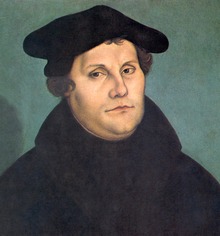
Martin Luther by Cranach-restoration.tif


No. It's not me. Calling me a radical Christian is like calling Donny Osmond an outlaw rocker. I'm referring to the feisty, often foul-mouthed, fiercely intellectual, tell-the-truth-and-damn-the consequences hero of the Christian faith pictured above: Dr. Martin Luther.

When Luther nailed his 95 Theses--an invitation to debate the accepted doctrine of the Roman Catholic Church--to the door of the Castle Church in Wittenberg, Germany on Halloween 1517, the theological fertilizer hit the fan with a splat (metaphorically speaking, of course!). Our world has never been the same since. AND, when you consider that he lived in an age when defiance of the Church could mean burning at the stake, well, you've just got to admire the guys' jewels (Again, I speak metaphorically).

Of course, I'm a Lutheran and so I'm pretty biased, but I think that an examination of Luther and his life and time would be pretty poignant about now. In the midst of the Arab Spring and the Occupy Wall Street movement, a look back at a successful revolution might be in order.

In Luther's day, supposedly pious churchmen openly colluded in the oppression of the masses. Fear of damnation was used to keep people in line--which also meant keeping many in poverty. Luther challenged the power system for its lack of charity as well as for its open greed and corruption. It was Martin Luther who introduced the concept of separation of Church and State. He also championed the cause of public education. His conviction was simple: if people knew the truth, their lives would change.

"...and you will know the truth, and the truth will make you free."
                                                                                     John 8:32

I often wonder what Luther would think if he were living in America today. I'm sure he would see that, 500 years after his own time, we are still very much slaves to sin--mostly the sins of greed and sloth. The biggest lie we too often believe is the lie that says, "There's nothing you can do about it."

Yet Luther did do something. He named the abuse and challenged the Church to correct itself. His defiance set off a spark that changed Western history. Sometimes I wish that we modern-day American Protestants had a little more PROTEST in us. I pray that we can see--from the life of a 16th Century German monk or the actions of a Tunisian street vendor--that one human life can make a difference to the world. We could use a little Luther about now.

+     +     +     +     +     +     +     +     +     +     +     +     +     +     +     +     +    

Now I trust all of my fellow Lutherans out there are ready to sing a rousing chorus of "A Mighty Fortress is Our God" for Reformation Sunday (October 30). This little ditty being, of course, the unofficial international anthem of Lutheranism. I do lament, however, that there aren't too many other songs we identify with the Reformation, and those in our hymnals seem to be a bit on the dull side, musically speaking. I have, therefore, taken it upon myself to compose a little up-beat rhyme which I humbly submit for your approval:

                                         
                                                           THE 95 THESES JINGLE
                                                      (sung to the tune of "Jingle Bells")

John Tetzel came to town,
And said, "Listen to me:
All your souls are bound
For Purgato-ory!
If you buy what I sell,
To Heaven you will go;
You can save your soul from Hell
If you cough up the dough!  Oh...

"Indulgences! Indulgences!
C'mon, don't be a dope!
They can save your precious soul,
They're each signed by the Pope!
Indulgences! Indulgences!
Buy quick before you die.
You'll help to build St. Peter's Church
And your poor soul won't fry!"

When Luther first got wind
Of old fat Tetzel's spiel,
He said, "This man has sinned;
His doctrine is not real!
If folks could read God's Word,
They'd know this is a heist.
These 'Blessed Coupons' are absurd,
Our hope's in Jesus Christ."  Oh...

Theses! Theses!
One to ninety-five.
Luther nailed them to the door
To keep true faith alive.
Theses! Theses!
Nailed to the old church door:
Put your trust in Jesus' blood
And don't rip off the poor!

Yes. I know. I have WAY too much time on my hands. Thanks for stopping in, my friend.

Thursday, October 20, 2011

What's Up With Tattoos? (Reflections on Pentecost 19)


"You shall not make any gashes in your flesh for the dead or tattoo any marks upon you: I am the Lord."
                                                                                              Leviticus 19:28

Say what?

I came across the above curious little verse while researching the assigned lectionary readings for the 19th Sunday of Pentecost. The liturgical theme of the day is all about the Law of God and the greatest commandments, so the Hebrew scripture lesson goes back to the big law book that is Leviticus. This always makes me a bit uneasy because there's some pretty freaky weird stuff in Leviticus. Like this prohibition against tattoos.

Truth be told, I'm kind of fascinated by tattoos and tattooed people. My daughter's left arm alone has got more art than the Louvre. And two of my favorite Christian evangelists, Jay Bakker and Nadia Bolz-Weber, each sport more ink than the press room at the New York Times. I think all three of them are pretty righteous people (although I don't actually know Jay or Nadia personally, but I still think they're really cool!), so I don't see why the ancient Hebrews got their shorts in a knot over a little skin art.

My guess is that the anti-tattoo stance came about because other tribes in the ancient Near East were into tattoos. The Hebrews wanted to be a people set apart from the other nations, so they chose to go tattoo-less. Today it's just the opposite--your ink marks you as unique and individual. It's a form of self-expression. To the ancient Jews, however, the lack of ink showed the world that they were unique: they were the people of Yahweh.

The Revised Common Lectionary, the set cycle of Bible readings used for Sunday masses by Lutherans and others, pairs Leviticus 19 and its laws--mostly laws respecting human dignity and fairness, by the way--with the Gospel lesson of Matthew 22:34-46 in which Jesus is asked which commandment is the greatest. Jesus gives it to them straight:

Love God.

Love everybody else.

That's it.

The love Jesus is talking about is God's love. It's not about passionate emotions or feelings. It's about respect and care. It's a doing kind of love. As you want it to be done for you, do it for others.

If you want to be acknowledged, acknowledge.
If you want to be fed, feed.
If you want to be respected, respect.
If you want to be healed, heal others.

It may be hard to love the concept of God. But anyone can love another person. This is the spiritual path, and it supercedes everything else.

So what about the law against tattoos? I say, "Screw it!" We don't have to live our lives based on a four thousand-year-old tribal code--even if it is in the Bible. As a Lutheran, I take the Bible seriously, but not literally. Luther always taught that if we got hung up on every word of scriptural law and tried to make ourselves righteous by strict observance, we'd turn into idolatrous slaves and turn the Bible into "the paper Pope."

(And if you know anything about Luther, that last part wasn't a compliment!)

So here's a shout-out to all the beautiful, pious, spiritual and tattooed out there. Yes, for my own part, I have to go along with my man Jimmy Buffet who called skin art "a permanent reminder of a temporary feeling." But I'm cool with however the rest of you want to express yourselves. That is, as long as we all remember that our ultimate expression has to be one that sees the love of God in the faces of our neighbors. Then we'll know we've kept the law and drawn nearer to the beating heart of God.

I love you, my neighbor. Thanks for dropping in.

Wednesday, October 12, 2011

Spirituality of Taxation (Thoughts on Pentecost 18)

"Give therefore to the emperor the things that are the emperor's, and to God the things that are God's."
                                                                       Matthew 22:21

Some years ago when I was leaving the seminary for my internship with a parish in New York, I tried to save some cash by hiring a cut-rate moving van company. When the truck pulled up in front of my apartment and the crew got out, I met three of the scariest looking dudes I'd ever seen. One look at these goons told me they'd surely done time in the joint.

"Please be careful with my stuff," I asked the head creepy guy as the crew began to sling boxes and furniture into the truck with simian abandon.

He snorted, spat phlegm, and grunted the least comforting words anyone in my situation could hear: "Don't worry, Dude. I'll treat it like it's my own."

Well that's just great, I thought. I don't know how this guy treats his crap. I want him to treat it like it's MINE!

I have this idea, you see, that if we're caring for something that does not belong to us, we just might, out of some sense of decency, show it a bit more respect. The real truth is, however, that absolutely nothing really belongs to me. I mean, I didn't bring anything into this world, did I? Theologically speaking, everything belongs to God. And maybe if I think of everything as being property of someone else--like GOD, for instance--I just might think twice about how I use it. That goes for the earth, the people I encounter, and the material resources I am privileged to use.

In Matthew 22:15-22, Jesus' political foes try to trap him with a very political question. Is it lawful to pay taxes to the occupying power? It's a simple Yes or No question designed to get Jesus jammed up. If he says yes, he alienates his base. If he says no, he commits treason and can be arrested. His answer: Give the emperor what belongs to the emperor and God what belongs to God.

But then, doesn't everything belong to God?

Personally, I don't think that rendering to Caesar and rendering to God are mutually exclusive.

There's a heck of a lot of noise in America today about the evils of taxation. A very vocal and, I think, misguided minority is hogging the microphone, trying to tell us that we are taxed enough already, and that the great panacea to America's woes will be to reduce taxation and the size of government.

But let's not forget why taxation exits in the first place. We come together and pool our resources becasue we cannot do on our own that which we can do collectively. We protect our neighbors from violence--natural or man-made. We educate our people. We build roads and shelters. We care for our sick, aged, and weak. We nurture our environment. We strive to create peace through international cooperation and acts of charity. We promote justice. We encourage and preserve our culture. None of these things sound particularly heinous to me.

Frankly, I'm more concerned about the soul of a nation that doesn't want to tax. To me, the message seems to be, "Nothing is more important than getting to keep what is MINE!" This culture of selfish consumption is poison to our spirit. And Jesus warns of it over and over again.

So tax me. If taxing me will heal a blighted neighborhood, enhance a school, advance a medical cure, give my brother or sister a job, rehabilitate a wounded veteran, or buy milk for a hungry child, tax me some more.

It's only money.

And it doesn't belong to me, anyway.

Thanks for stopping by. Leave me a comment and let me know you were here, will you?

Thursday, October 6, 2011

Does Heaven Have a Dress Code?

Some Bible passages really bug me.

The Gospel lesson for the 17th Sunday of Pentecost (That's Lectionary 28 if you're keeping score at home) is one of those pain-in-the-you-know-where stories. It's the Parable of the Wedding Banquet (Matthew 22: 1-14). The story goes like this: A king is throwing a wedding banquet for his son. He invites a bunch of his vassels, but they scorn the invitation. When the king learns that they have mistreated and, in some cases, actually murdered the slaves he's sent to command their attendance, he retaliates by sending in his troops to slaughter the vassels and burn their city.

(Lovely guy, isn't he?)

The king then sends out his slaves to invite anyone they encounter--any sorry dufus they meet on the road--to join the feast. This makes for a good enough party until the king notices that one of his guests isn't wearing a wedding garment. Since the poor slob can't give a good explanation of why he's in the banquet hall of the roayal palace in his cut-offs and flip-flops, the king calls the royal bouncers to tie him up and toss him out.

This king is really a sweetie. Can you guess why I get a little uncomfortable with interpreting the king in the parable as analogous to God?

Granted, I've got a retired guy in my parish who probably can't wait to hear me preach on this parable. He's one of the last of the coat-and-tie types, and he gets really pissed off when folks show up to Sunday mass looking like they've just washed their cars. A big part of me sympathizes with him, too, because I really fear that we in America are turning into a nation of slobs. I mean--for cryin' out loud!--we actually watch Jersey Shore!

But I digress...

Personally, I don't give a rip how people look when they come to mass as long as they come.

But as to the parable: Matthew's version of this story differs from other sources, so he's probably editorializing a little for his own audience. Really smart Biblical scholar guys think that Jesus' original version may have gone something like this: A king threw a wedding feast. The swanky people he invited didn't want to come, so he opened his doors to the dirty, funky, common folks instead. Amen.

I like this version better, don't you? It's got a lot more mercy and grace in it. Jesus' point in telling this story to the priests and Pharisees may have been that our history or pedigree is not what makes us God's children. If we lack the passion for righteousness--for mercy, love, equality, and compassion for others and the joy of being God's creatures--someone else will be invited to the party in our place. Someone else will fulfill God's plan--maybe someone who is not a bit like us at all.

I think it's a good idea to read this story and cast ourselves in the role of the priests and Pharisees. We may be missing the real party because we're so busy trying to preserve the institutions of our congregations or denominations. That is, we've done church for so long we've forgotten how to be church. Also, I think that as Christians we've grown accustomed to interpreting the "new" wedding guests as ourselves while seeing our Jewish forebears as the "disinvited" ones. This interpretation may be a bit closer to Matthew's original intention, but it doesn't do anything for us except make us feel smug. And smugness is so unattractive, don't you think?

(Now if you want to get real technical about this, we can probably guess at why Matthew adds the violence to this story. The killing of the slaves who bring the invitation can be seen to reflect the killing of the prophets and the death of Jesus himself. The violent retaliation in which the city is destroyed could be intended to allude to Rome's destruction of the Jerusalem Temple in 70 CE. In this analogy, the old chosen ones, Israel, have been punished and God has chosen a new people, the Christian Church. This is interesting historical speculation, but knowing it is not bringing me any closer to God. Plus, it's disturbingly anti-Semitic.)

The interpretation of this parable that floats my boat is to see it as a description of God's inclusiveness. In verse 10, the slaves gather everyone--the good and the bad, the saints and the sinners. They're the people off the street, the people whom Jesus loved.

Of course, we're still stuck with the problem of that dude who violated the dress code. Let's assume for the moment that he actually owns a wedding garment, and that he's just being rude by not bothering to wear it. I mean, my mom always taught me that one dresses to compliment the host or hostess, but this guy can't seem to make the effort. (I'd hate to see anyone kicked out just because they couldn't afford a nice shirt and tie, you know?) What might this guy represent?

Here he is in his smelly t-shirt, eating the free food and taking advantage of the hosted bar. He might be like a lot of church folk--believing in a sense of God's mystery, but not passionate enough to do anything about it. He comes to church out of a sense of obligation, and turns to God only in moments of want or distress.

There's a word for people like that: superstitious.

Now you ask, what is the difference between religion and superstition? In superstition, we try to appease God, thinking that our actions--be they prayers, rituals, or half-hearted observances--will change the way God behaves toward us. In true religion, however, we ask that the way God is--beautiful, giving, creative, loving--will change the way we are towards God and our fellow creatures.

I don't know about you, but I want to come to God's party properly dressed. I want to be covered in my own humility and willing to let myself be changed. I want to be welcoming to all the other guests, and I want my presence to be a compliment to my very gracious host.

Thank YOU for being a guest on my blogsite. I'm honored that you've stopped by. Please feel free to leave me a comment. It's always great to hear from you.