Wednesday, April 17, 2019

Peter the Doofus, Part II (Reflections on the Resurrection of Our Lord)


Image result for Images of Peter at the Tomb
“…then he went home, amazed at what had happened.”

So when we last left our hero, Simon Peter, he was having a pretty rough night. He’d just made a big hoopla out of his love for Jesus, and then he fell asleep when his friend needed his company most, he ran away when his friend was in danger, and—last but not least—he denied three times that he even knew Jesus.

And when he’d taken stock of his behavior, he went out and wept bitterly.

Wouldn’t you? I mean, just how would you feel if you were Peter? When I try to put myself in this guy’s sandals, I get pretty darn depressed. He’s lower than whale crap in the Marianas Trench. This is the time when you either kill yourself or let the drugs and the alcohol do it for you because you just don’t give a rip anymore. This is where you realize you’ve made a pile of smoking garbage out of what was supposed to be your life.

Look at it: Peter quit his good job to follow an itinerant rabbi. He also turned his back on his dad when he did this. He left his home. Now he knows he doesn’t have the guts to stand up for the cause he claimed he’d left everything for. He’s a false friend, a braggart, and a coward—and everyone knows it. He’s a giant, slimy bag of shame and disgrace. He’s disappointed himself, and he’s let his best friend down. What’s worse, he let his buddy get killed. And when Jesus died, all the dreams died with him.

I can’t imagine what went through peter’s head all day Friday and Saturday when Jesus was hanged on the cross and his corpse was put in its tomb.

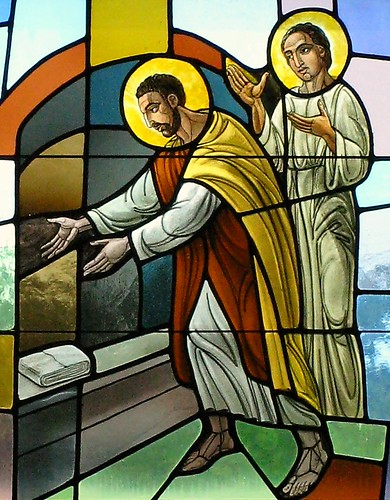
But then came Sunday. Some crazy chicks came and said that tomb was empty. Nobody believed them. Nobody could believe them. It was impossible. I’m not sure Peter believed them either.

But he got up, and went to check it out. He summoned up one last speck of self-worth, one last desperate hope, and went to the tomb.

The New Revised Standard Version of the New Testament says he was “amazed.” The word in Greek could also mean “shock” or “wonder.” Personally, I think the word “amazing” is a little wimpy because it’s overused. “Shocked” is possible if you go with the idea that Peter was witnessing a pretty disgusting grave robbery. But I want to go with “wonder.” When you wonder about something, you have an anticipation. Wonder leads you forward. Wonder, if you’re in Peter’s place, is the moment when you put the gun back in the drawer or the sleeping pills back in the medicine cabinet. You pour your bottle of Jack Daniels down the sink and chuck your syringe in the garbage can. You suck it up and decide you’ll see if maybe something happens tomorrow.

And now Peter can wonder if the God who gave him life doesn’t just have the power over life and death. Now he can wonder if this end isn’t really the end after all.

When Peter encounters the risen Jesus he’s changed. Once he was just a doofus. But in Christ, he’s still a doofus—but he’s a doofus with hope. Yeah, he’ll go on to make a few more screw-ups. God will send him a radical vision of inclusivity, and he’ll try to argue his way out of it.[i] When some Jewish Christians demand that converts be circumcised, he’ll cave in to their demands[ii], but Paul; will set him straight by calling him out in public.

He’ll go on in faith to spread the word, according to legend, all the way to Rome itself. And the legend will tell us that when things got too hot for Christians during the reign of Nero, Peter would scoot out of town again. But then he would stop. And come to himself. And he’d go back to comfort and strengthen those who were being persecuted—even though it meant he would be crucified himself. And, of course, flamboyantly humble to the end, he would insist on being crucified upside down as he said he was not worthy to die as Jesus had died.

We remember his impetuous mistakes. But we cherish his compassion and his love and his true faithfulness to this day. And like Peter, we are called to wonder if our own tears and shame and weaknesses and bitterness and folly can be erased by what the Almighty God is in the process of doing for, in, and through each of us. We saw Jesus enter into all of our human pain—he even knew the despair of Peter when he cried from the cross, “My God, my God, why has thou forsaken me.” But if he was united with us in our suffering, we must be united with him in his immortality.

And that is something to wonder about. Because wonder leads us to hope. And hope leads us to faith, and faith leads us to peace.

Christ is risen! Allelujah!


[i] Acts 10:9ff (Note vv. 14-16)
[ii] See Galatians 2: 11-14

Tuesday, April 16, 2019

Peter the Doofus, Part I (Reflections on Maundy Thursday)

Lucas Cranach the Elder (Woodcut, Ger, early 16th Cent.)

…once you have turned back, strengthen your brothers.” (Luke 22:32c)

Peter is such a doofus.

Every year on Maundy (or “Holy” if you prefer) Thursday we get this wonderful reading from John’s Gospel (John 13:1-17, 31b-35) in which Jesus washes the feet of his disciples. Peter plays a big role in this story, and his doofusness is really highlighted. He has to make a big show of his humility. He can’t let his rabbi and master wash his feet. No. He’s got to be the show-off and protest against the indignity of having the boss do the work consigned to slaves, children, or other underlings.

In a way, that’s very respectful of old Simon P. One of my most faithful and conscientious parishioners once caught me in the act of unstopping the church men’s room toilet. “Pastor,” he said, “what are you doing? Let me do that for you. You have too many important things to do than fix and clean the john.” I thought that was very nice of him, but, truth be told, if I’m really going to be a disciple of Jesus and a leader of the congregation, I shouldn’t ask anyone to do something I’m not willing to do myself. Don’t you think?

So Jesus does the slave’s work, and Peter gets all bent out of shape. He doesn’t quite get that in letting Jesus love him through humble service, he will be united with Jesus when he loves others in humble service. No. Peter has to show off how humble he is. He did this before when he told Jesus to depart from him just before he became a disciple (Luke 5:8). When Jesus points out that accepting this act of love is crucial, Peter still has to make a big deal out of it by insisting Jesus wash his hands and head too. But making a big deal out of stuff is what Peter does. Did you notice how he wanted to walk with Jesus on the water (Matthew 14:22-33), or how he wanted to build tents for Jesus and his “guests” on the mount of the Transfiguration (Luke 9:33)? I mean, this guy can never just let Jesus be Jesus. He’s always got to make it about himself somehow.

Don’t you find people like that irritating? It makes you wonder if Peter isn’t kind of insecure or something. What’s he trying to cover up? Why does he always have to go the extra mile? Is he suffering from some sort of feeling of inadequacy?

Of course, Jesus see through him. He sees past all the braggadocio bluster and BS that Peter puts out. And he has faith in Peter, all the same.

You see, this night isn’t going to end well for Simon Peter. He’s going to make some really outrageous claims of devotion and faithfulness to Jesus, and he’s going to bail out on all of them. Before the night is over, he’ll fall asleep when Jesus most needs his company and friendship. He’ll run away to save his own butt when the guards come to arrest his friend. He’ll even claim he doesn’t know who Jesus is. But Jesus already knows this about him.

In Luke’s version of the Passion story, there is a marvelous verse in which Jesus tells Peter that he’s praying for him:

“Simon, Simon, listen! Satan has demanded to sift all of you like wheat, but I have prayed for you that your own faith may not fail; and you, when you have turned back, strengthen your brothers.” (Luke 22:31-32)

Jesus knows how weak Peter is, but he also sees how strong he has the potential to be. He knows Peter is going to screw up. He also knows Peter will “turn back” or come to his true self at some point, and when that happens, he’ll be a leader and inspiration to the others.

In the Maundy Thursday Gospel we see Peter hiding his weakness—just like we all do. I saw a message on a church signboard this week which read: “You aren’t who you think you are. You are who you hide.” I guess we all try at times to hide our fears and the knowledge that we’re really nothing special. We’re all as sinful, as scared, and as mediocre in our own ways as the next person. The good news is Jesus sees past this. Jesus loves us and is willing to wash our feet. He’s willing to do the dirty work for us because we are so beloved by him. And not because of anything we do or say ourselves.

On Maundy Thursday, we are commanded to love the way Jesus loved us, and to come to the table to receive that love. Martin Luther pointed out that the only qualification for getting an invite to this Thanksgiving dinner is to believe that it’s really for us—for YOU, my friend—because Jesus has forgiven all of your shortcomings and loves you for who you are and who you can be.

You are invited because Jesus believes in you.

Come. Eat. Be at peace with yourself. You matter.

Wednesday, April 10, 2019

Let It Out (Reflections on Palm Sunday, Year C)


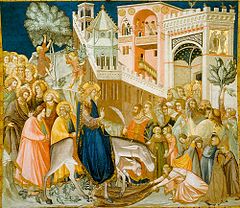
Assisi-frescoes-entry-into-jerusalem-pietro lorenzetti.jpg
“He answered, ‘I tell you, if these were silent, the stones would shout out.’” (Luke 19:40)

Well it looks like somebody got baptized here in Philly. Yup. On Opening Day of the Phillies baseball season at Citizens Bank Park, right fielder Bryce Harper—the slugger we’re counting on to lead us to the World Series, the dude we’re paying 330 million dollars to have on our roster—wiffled twice at bat and was greeted by a chorus of boos from disappointed fans.

But, hey! He surely must’ve expected that if knew anything at all about Philadelphia sports fans. We’re willing to greet his arrival as triumphant with loud “Hosannas” when he signs with our club, BUT: if he racks up two big, ugly K’s in his first two times at bat, we’re going to boo his ass.

Harper’s Opening Day odyssey is kind of symbolic of the meaning of Palm Sunday, don’t you think? Here’s Jesus arriving in town with much fanfare by his followers. They’re praising God for all of his past deeds of power. There is, however, a big, black, nasty raincloud hanging over this little parade. We know the rest of the story. We know that all the cheers and praises are going to fall silent when this guy doesn’t turn out to be the person the crowd wants him to be.

Palm Sunday, for all of its festiveness, is a reminder of how fickle we are as people, how short-sighted, and hung-up we are on instant gratification. It doesn’t take even a week for the most devoted of disciples to scatter and deny they even know Jesus.

This year we look at the story as it appears in Luke’s Gospel (Luke 19:28-40). Do you notice something missing here? Of the four Gospels, Luke’s Palm Sunday story is without palms. It’s been suggested by smart, Bible scholar folks[i] that the palms were used to welcome political or military heroes. Waving the palms for Jesus would suggest that he was coming to take political power, so Luke—who is always trying to make Jesus as palatable to the Romans as possible—omits this detail from his account. Since the other Gospels do mention the palm, I tend to think palms got waved. Luke just didn’t want to rock any boats by mentioning them.

What Luke does mention is the reaction of the Pharisees to the praises being sung by Jesus’ followers. This type of joy and praise is just unseemly to these guys. Maybe they don’t like to upset anything. Maybe they’re comfortable with how things are. If so, that’s a real shame, because the way things are isn’t too great. In five more verses Jesus will enter the Temple of Jerusalem and call out the chief priests for their sacrificial animal-selling scam. Jesus clearly refers to the temple as “a den of robbers,” (v.46), so you know somebody was getting ripped-off.

If you think about it, that was a pretty daring thing to do, and doubtless led to Jesus’ death on the cross. But it had to be said. Somebody had to speak the truth. In the Kingdom of God, there is no pretending. The dirty little secrets will come out, be repented, and be forgiven, or they will eat through us like acid. God’s truth will out.

If our churches aren’t speaking for justice, mercy, and peace, someone else will do it. If you aren’t saying what needs to be said, someone else will. If we all stay silent, the truth will still be the truth and it will come out some way, somehow. The Pharisees didn’t want to hear about a messiah of acceptance, inclusion, forgiveness, and love. But if Jesus’ disciples were silent, the very stones would cry out his name.

Have you had a chance to witness to your faith? Don’t be silent. Let it out.


[i] See the Interpretation commentary by Fred Craddocck from John Knox Press, 1990.

Wednesday, April 3, 2019

Costly Devotion (Reflections on Lent 5, Year C)


Image result for images of Mary anointing Jesus' feet
“You always have the poor with you…” (John 12: 8a)

So I’m reading again the Gospel lesson in the Revised Common Lectionary appointed for Lent 5, Year C (John 12:1-8). It’s that story of Mary of Bethany anointing Jesus’ feet with some really expensive perfume and wiping his feet with her hair. You know the one I mean? I’m reading it and I’m thinking, “Really, Homegirl, isn’t that a bit excessive?” The Bible commentaries tell us that a denarius was the average daily wage for a working man in Jesus’ day. If you consider that in today’s terms, a 300 denarii pound of nard would run you about $17,400.00[i]. Add to this the fact that Mary wipes the ointment on Jesus’ feet with her hair!

I mean, come ON..! That action alone is kind of sexy and not at all seemly in the context of her time and culture. It does, however, demonstrate how totally devoted she was to Jesus. I guess the gratitude she had for getting her brother Lazarus back from the grave was overwhelming.

But is it possible that we can overdo devotion? A salesman in one of the church good stores once asked me if anything were too good for the house of the Lord. I replied that I didn’t think so, but many things were too expensive for Faith Lutheran of Far Northeast Philadelphia. Some years ago I bought a set of chasubles online. I chose the least expensive set of plain, polyester vestments I could buy—not because I’m cheap (although I kind of am), but because anything more elaborate would look pretentiously out of place in my cinder block, working-class church.

I recently showed my Confirmation class the 2003 MGM movie Luther. If you’ve seen it, you’ll recall the scenes in which the radical reformers riot and begin to smash stained glass church windows and pull down devotional statues. This was a reaction against the wealth of a church which was an oppressive force in their lives. I believe that the absence of the Christ figure on crosses in Protestant churches is not, as I was always told, an emphasis on the resurrected Jesus. Rather, the simplicity of the empty cross was the peasants’ reaction to the extravagant wealth of the Roman church which paid a fortune to adorn their houses of worship with images of Christ crucified at the expense of charity to the poor.

One can almost see Judas’ point when he criticizes Mary for her effusive display of devotion to Jesus. Surely, better use could’ve been made of her money than to pour it on her rabbi’s feet.

So what does Jesus have to say about this? He defends Mary. It seems she’s only pouring out a little nard. She’s keeping the rest of it (see verse 7) for Jesus’ burial. If you think about it, it’s one thing to give someone a really nice funeral. It’s far better to show your love for them while they’re still with you.[ii]

But maybe Jesus is aware of Judas’ ulterior motives. Otherwise, why would our evangelist mention them (v. 6)? Judas, like hypocrites before and since, has a truly slick talent for disguising his own greed with virtue. A large donation to the common purse meant a hefty commission for the treasurer.

Ain’t that always the way?

Someone says, “Don’t burden the poor with a healthcare tax or a mandate to purchase costly insurance.” Translation: “Let poor people get sick and die or be overwhelmed with debt because healthcare is unaffordable and insurance companies don’t want to cut their profits.”

Or, someone says, “Don’t strangle business with cumbersome regulations.” Translation: “Let companies pay starvation wages, deny benefits, and pollute the earth all they want so they can make more money.”

And of course, “Protect our American constitutional freedoms from godless socialism.” Translation: “Let banks charge all the interest they want. Give tax breaks to billionaires. Screw gun control!”

But what about that cryptic phrase, “You always have the poor with you?” Lindsey Trozzo of Princeton Theological Seminary helps us by pointing out that the indicative form of the verb in Greek (the form that states a fact) is the same as the imperative form (the form that gives a command)[iii]. So when Jesus says “You always have the poor with you,” it could also be translated as, “You (I’m talking to you, plural. All you Christian folks) are always to have the poor with you. Even when the physical Jesus is gone, he is still present in the form of the ones he loves—the poor.

If we are to pour ourselves out in costly devotion, perhaps our best investment will be to love the unlovable and the forgotten. In such a way, we will never overdo devotion. As the old hymn says:

What shall we give him in costly devotion?
Shall we bring incense and off’rings divine,
Gems of the mountain or pearls from the ocean,
Myrrh from the forest or gold from the mine?

Vainly we offer each ample oblation,
Vainly with gifts would his favor secure;
Richer by far is the heart’s adoration,
Dearer to God are the prayers of the poor.
(Reginald Heber: “Brightest and Best of the Stars” vv. 3-4. Evangelical Lutheran Worship, hymn 303)

God bless you, my friend. Please come again.


[i] I’m basing this on an 8 hour day at Pennsylvania minimum wage of $7.25 per hour. Multiply that by 300 and you get one pretty darn expensive bottle of perfume!
[ii] I’m reminded of the words of a great Philadelphian, W. C. Fields, when asked to be a pallbearer at the funeral of fellow Philly guy, John Barrymore. “The time to carry a pal is when he’s alive,” Fields said.
[iii] You can read Lindsey’s insightful commentary on this passage by clicking Lindsey.


Wednesday, March 27, 2019

It's a Family Thing (Reflections on Lent 4, Year C)

"The Return of the Prodigal Son" Rembrandt (c. 1661-69)

So, okay. We all know the parable Jesus preaches in the Gospel lesson appointed for Lent 4, Year C in the Revised Common Lectionary (Luke 15: 1-3; 11b-32). It’s been lovingly called “The Parable of the Prodigal Son,” and I have a sneaking suspicion that it’s the most famous of Jesus’ parables because it’s the most relatable.

Yeah, for good or ill, we all have families. And for good or ill, just about every family with more than one kid has a kid who gets more attention from Mom and Dad than the others. And there’s always that one kid who ends up looking after an aging parent, doing the shopping, driving Mom to the doctor’s, or cutting Dad’s lawn when Dad gets too old to do it and buying his Depends for him.

When Mom and Dad go home to their Heavenly Rewards, leaving the estate equally divided between faithful you, your dead-beat brother, and your junkie slut sister—I won’t be surprised if you feel a little bit slighted and resentful. Just like that older brother in the parable. You did all the work, darn it! Why should they share in the profits..?! It’s just not fair!!!

Because we include verses 1-3 in this reading text, we assume that Jesus is casting the perpetual “bad guys,” the scribes and Pharisees, in the role of older brother. They resent that Jesus should honor a bunch of sinners, traitors, whores, etc. with his presence and his charitable gospel. But Jesus sums it all up in verse 10 by saying:

“Just so I tell you, there is joy in the presence of the angels of God over one sinner who repents.”

Pretty much speaks for itself, doesn’t it?

But what’s so cool about this particular parable, I think, is that it works on many levels. Any one of us could play any of the three major characters in this story. You may, indeed be the faithful one who has played by the rules all your life and goes a little whack-o when you see someone you think is “undeserving” being shown mercy or compassion. We’ve all felt jealousy or the injury of being overlooked and under-appreciated. It’s not that easy to tell yourself that the good fortune of another is no threat to your sense of self-worth or dignity. Elections have been won by playing on people’s sense of wounded entitlement. But God asks more from us. God asks older brothers to look with the Father’s eyes.

Looking with the Father’s eyes may not be an easy trick if you happen to be playing the role of Prodigal Son. Maybe you’ve been in this part yourself. Maybe you’re in recovery, you’ve gone to jail, or you’ve been bankrupt, divorced, fired, expelled, or screwed up in the infinite number of ways human beings screw up. Or maybe you just haven’t been to church for a really long time, and you’re afraid people will judge you and ask where you’ve been when you slink your backsliding butt back in through the church doors. Maybe you know you haven’t pulled your share of the load, and you’re ashamed to face the folks you think have done. Maybe you wonder if arms will still be opened to you.

And maybe you’re playing the role of the Dad in this story. Ya think? Yes, you may be saying, “Wait, Old Religious Guy, isn’t the Father supposed to represent God? I would never presume to cast myself in this role.” Oh no? If we’re honest, we all either are, will be, or in some way cast ourselves in the role of a parent. Personally, I never mind when folks in Northeast Philly address me as “Father,” because a pastor, like a parent, is a person who has complete responsibility for something over which they ultimately have no control. Although I have no biological kids of my own, I still feel a little sting when one of my Confirmation kids affirms his or her baptism in a solemn liturgy and then disappears out the church door, never to be seen again.

Like the dad in this parable, we all have the potential to feel the pain of someone we care for who goes and runs their life into the crapper. We know what it’s like to be looking toward that foreign land, scanning the horizon, in the hopes that an angry, addicted, confused, or obsessed child might one day make his or her way back into our lives and our hearts.

We all play the dad role. We all feel the pain, and we face the challenge to pray and hope and welcome and rejoice for a restored relationship. May God grant us the courage to come to ourselves, ask forgiveness, and accept the forgiveness that’s granted. May we be willing to put compassion for others above our selfishness. May we learn to love through the hurt of our humanness.

God’s peace be with you. Thanks for visiting me this week.

Wednesday, March 20, 2019

There's Still Time to Fix This (Reflections on Lent 3, Year C)


“…unless you repent, you will all perish just as they did.” (Luke 13:5)

So why does God let terrible things happen? Is it righteous judgment, or is it just because, as the old saying goes, “shit happens?”

In the gospel lesson appointed in the RCL for Lent 3, Year C (Luke 13:1-9) Jesus is confronted with news of a pretty terrible act perpetrated by Pontius Pilate. If you read about ol’ Pontius in any of the histories of the ancient world (like those of Flavius Josephus for example), you’ll soon see that he wasn’t a very nice guy, and terrible acts were kind of his thing. He was something like a Nazi camp commandant. His job was to keep the peace at all costs, and he wasn’t too delicate about how he did it. Even though Josephus doesn’t record the massacre of Galileans from our Gospel lesson, he does record that killing a bunch of folks while they offer sacrifice was just the sort of thing Pilate was famous for doing.

But what does that say about the victims? Jesus’ remarks in the Gospel seem to suggest that those who asked him about the massacre held the old-fashioned belief that rotten things happen to people who deserve them. That is, if a ruthless minion of a totalitarian state has a brutal soldier gut you like a fish while you’re in church, it’s obviously because you had it coming. You must’ve offended God in some way or God wouldn’t let this happen to you.

This is kind of like the logic used by the late (albeit not-so-lamented-by-me) Jerry Falwell and the not-late-enough Pat Robertson following the terror attacks on September 11, 2001. Falwell opined that America’s tolerance of LGBT people, refusal to have prayer in public schools, and pro-choice abortion policies angered God to the point that the Almighty allowed terrorists to fly planes into buildings and take the lives of over 3,000 people. Such an opinion is, of course, just plain, bigoted goat crap—the sort of bigoted goat crap we’ve come to expect from Robertson and Falwell.[i]

Jesus’ answer to this “blame the victim” supposition is that the folks who died weren’t worse sinners than anyone else. Bad stuff just happens in this world, and it sometime happens unexpectedly. Don’t try to read God’s mind. It won’t help. Just get your own act together.

Luke’s Gospel marries this story of the Galilean massacre and the fall of the tower of Siloam with a parable about a fig tree which doesn’t bear any fruit. The landowner is about to cut it down, but a wise gardener gives it a reprieve. He asks the boss if he can tend and fertilize the tree first. If that doesn’t work it will be okay to uproot it. He grants the figless tree a little more time.

We’ve been granted more time, too. If you’re awake and can read these words, you have time to get your act together. You’re being called, as, indeed, we all are, to repentance. We’re called to a changing of our minds to be the people God wants us to be—and not because that will save us from unexpected catastrophe, but because we will feel more fully alive and at peace in the time that is granted to us.

Last Friday, a cyclone hit the nation of Mozambique taking the lives of possibly 1,000 people, flooding the city of Beira, and putting almost 100,000 human beings in danger of flood waters. Are the folks in Mozambique less pleasing to God than any others of God’s children? Yet unless we pull our heads out and recognize the dangers of a changing climate, we may all perish as they did.[ii]

On the same day, some idiot white supremacist entered a mosque in Christchurch, New Zealand and opened fire with an AR-17. He killed 50 people and wounded 50 more in their place of worship. Are the Muslims of New Zealand worse sinners than you or I? But unless we start teaching children tolerance, unless we recognize that we live on a small and crowded planet with people who are also made in the image of God, we might just face an endless cycle of terrorism and revenge.

This week I have invited a teacher form the Muslim Youth Center of Philadelphia to address my Confirmation class. My hope is that the students will meet a person from a different culture and a different religion without fear or condescension, and learn to look upon such a one with honor and respect. I pray they will grow up with a spirit of hospitality and love for all whom God has made.

The good news is this: we still have time to change. What are we waiting for?


[i] Yup. They really did say this. You can see for yourself by clicking Falwell. 
[ii] Do you want to help the cyclone/flood victims? Give to Lutheran World Relief. Click LWR.

Thursday, March 14, 2019

Someone's Got to Do It (Reflections on Lent 2, Year C)

 Image result for eric liddell


When somebody tells me about their vacation to some restful or exotic place, I often sarcastically reply, “Well, it’s a tough job, but someone’s got to do it.” That’s to say I guess someone needs to be enjoying themselves while the rest of us keep pounding away at our jobs, trying to keep all the plates spinning on their appointed sticks.

But do you know those people who seem destined always to do the difficult, dirty jobs? You know: the ones who make us want to say, “Better you than me, Dude.” They’re the ones who just push ahead in spite of danger or the promise of ridicule or the expectation of very little reward. They’re like Abram in the First Lesson appointed in the RCL for Lent 2, Year C (Ge. 15:1-12, 17-18). This poor guy keeps going ahead, following God’s direction; nevertheless, when we meet him in this story, he doesn’t seem to be getting what he wants. He’s doing his part, but God isn’t coming through with the promised reward of a son and heir. God keeps promising and Abram keeps obeying and journeying on. And waiting.

Then, of course, there’s Jesus in the gospel lesson (Luke13:31-35). He knows he has to go to Jerusalem. Not because Herod is threatening him in Galilee. Not because the Pharisees want him out of their back yard. Because the tough job that he is committed to doing is in the city that kills the prophets and stones those who are sent to it. And even though he knows he’s going to face rejection, he still longs to be there, and he looks upon the ones who will turn on him with the protective love of a mother hen. Better you than me, Jesus.

For a saintly example, I think of the Scottish Olympic athlete Eric Liddell, considered the most popular sports hero in Scotland to this day.[i] Liddell won the gold medal in the men’s 400 meter at the 1924 Paris Olympics. He’d originally been slated to run in the 100 meters, which was his best sprinting event. He refused the event, however, because the heats were to be held on Sunday. Being a devout Calvinist, he felt that competing on Sunday was a sin against the Sabbath.

Following a record-setting win at the Olympics, Liddell could’ve gone on to a career in pro athletics. He was famous and popular and was an accomplished rugby player as well as a runner. He chose, however, to follow in his parents’ path and became a Christian missionary to China. He served in the Orient for the better part of two decades, first as a teacher of English for the children of wealthy Chinese, but later as a medical missionary in one of the poorer provinces. In 1943, after disregarding a warning from the British foreign office to evacuate, Liddell was captured by the invading Japanese and sent to an internment camp. There he became a kind of camp pastor, ministering to the spiritual needs of his fellow detainees, teaching the Bible, and coordinating the social life of the camp. He died there in February of 1945, just five months before the camp was liberated. The cause of his death was believed to be a brain tumor, exacerbated by hard work and malnutrition.

I don’t imagine anyone reading this post is feeling a calling to go to a dangerous or strange place for the sake of the Gospel. Certainly none of us are about to go and get ourselves crucified, either! BUT:  you may already be in your “Jerusalem” or your “China” (if you wish to use the example of Eric Liddell). You may be in a strange love-hate relationship in which you have great compassion for some person or persons, yet all you face is rejection, frustration, longing, or disappointment. The mother hen, after all, may protect her chicks under her wings, but she’s the one the fox eats first. Perhaps you struggle with parenting, volunteering, or being a witnessing presence in your workplace or school of neighborhood. Perhaps you, like Abram, are asking, “How long, O Lord?”

It’s a tough job, my friend. But someone has to do it. And that someone, today, is you. Now is the time to ask how your serving makes a difference. Now is the time to decide whether your efforts are a sacrifice or a waste. If they’re the former, then it’s time for you to start thanking God for the opportunity to be who you are where you are.

Wait for the Lord;
    be strong, and let your heart take courage;
    wait for the Lord!
(Psalm 27:14)

Thanks again for reading this week!


[i] Liddell’s story is part of my favorite sports movie, Chariots of Fire. If you’ve never seen it, I’m sure you can get it on Amazon or Netflix.